KnoWhy #852 | May 12, 2026
Why Was the Conquest of Jericho More Important Than What Some in Israel May Have Realized?
Post contributed by
Scripture Central
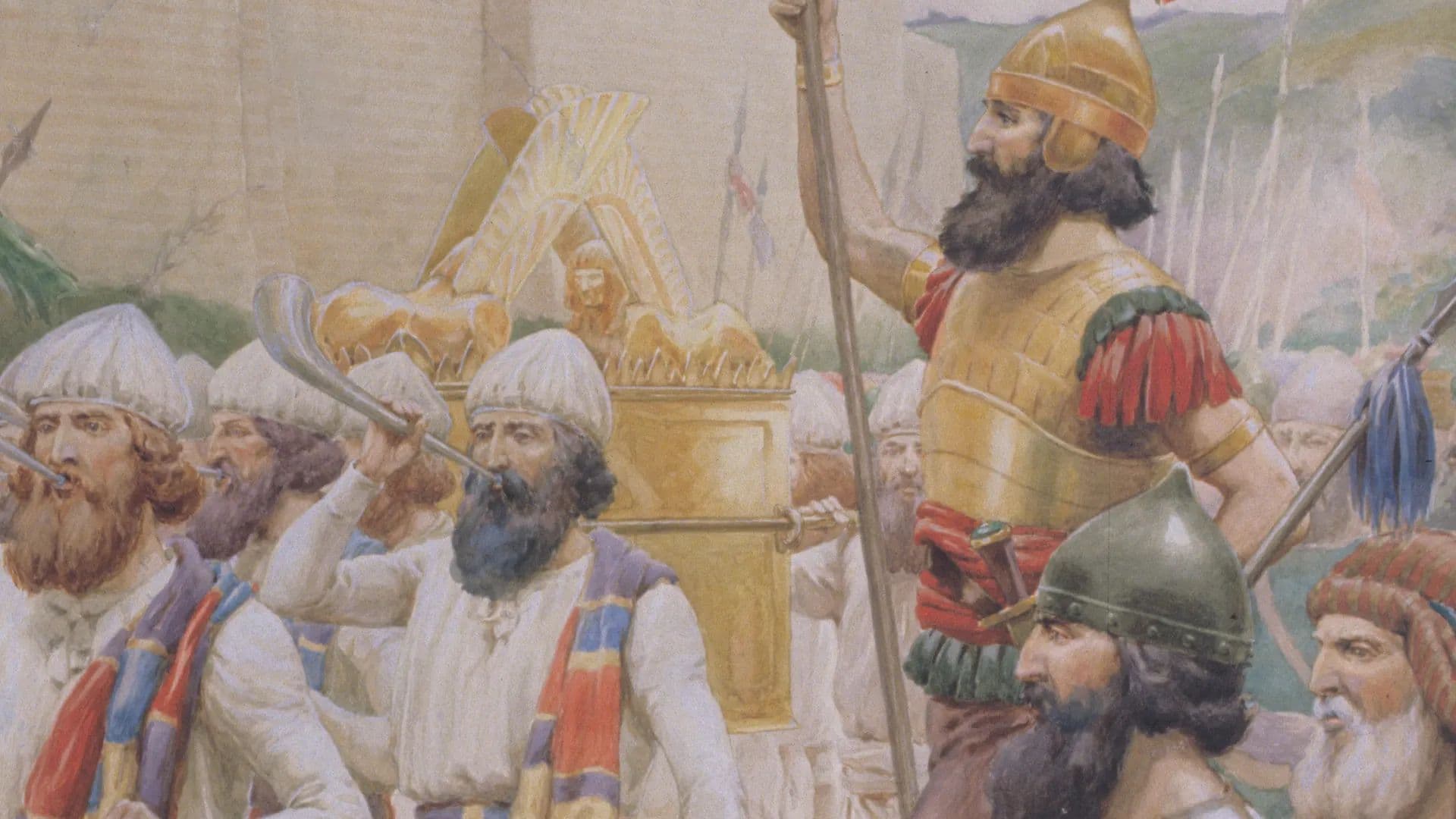
“And the men of Jericho fought against you, the Amorites, and the Perizzites, and the Canaanites, and the Hittites, and the Girgashites, the Hivites, and the Jebusites; and I delivered them into your hand.” Joshua 24:11
The Know
Most readers of the Bible are familiar with the story of Joshua’s conquest of Jericho, as recorded in Joshua 6. However, additional reasons the Lord may have called upon the Israelites to conquer Jericho only become clear when one examines a particularly mundane piece of evidence: pottery. Evidence gleaned from ancient potsherds suggests that Jericho and cities like it may have provided the ancient Israelites with enough water to supply multiple settlements in the arid highlands where water was lacking.1
A surprising thing about many early Israelite sites is where they are located. The Canaanites settled near springs, a reasonable thing to do in their arid environment.2 In contrast, the Israelites often settled on rocky outcroppings on hilltops, far from any significant water supply.3 Some of these Israelite settlements solved the problem of water by digging pits for water called cisterns, but some sites did not have springs, or cisterns.4
Archaeologists were puzzled as to how the Israelites could survive in environments like this until they noticed something unusual in the ruins of these apparently waterless sites: the presence of significant numbers of massive pots called “large pithoi.”5 These pots were large enough to hold significant amounts of water, enough to sustain a household.6
As archaeologists examined the remains of these large pithoi, they noticed something else as well. Each of these settlements that contained these pithoi was close to another settlement with a spring.7 They were close enough that people could have hauled enough water from the spring to survive in their waterless villages.8 This dependence on springs in neighboring towns emphasizes the significance of the conquest of Jericho.
Jericho, like many other large settlements at the time of the conquest of Canaan, was fed by a spring. This spring, now known as the Ein es-Sultan Spring, is particularly impressive. It produces 1,000 gallons of water per minute, which would have been more than enough water to sustain not only Jericho but many other nearby settlements.9 This means that the conquest of Jericho and other spring-fed cities of Canaan would have allowed the Israelites to create many settlements across the hill country.10
The conquest of Canaan did not happen overnight, or even over the course of a few months, as one might think if one only read the first half of Joshua.11 Joshua 13:1 states, “Now Joshua was old and stricken in years; and the Lord said unto him, Thou art old and stricken in years, and there remaineth yet very much land to be possessed.” Joshua 13:2-6 lists the significant amount of territory the Israelites had not yet conquered, and Joshua 17:14-18 and 19:47 states that the conquest continued slowly over time, something also described in Judges 1.12 Thus, cities like Jericho with springs that could produce copious amounts of water, would have allowed for the Israelites to create many hilltop settlements across the highlands in areas they would not have had to conquer, facilitating their slow expansion into the rest of Canaan.13
The Why
The conquest of Jericho was clearly a miracle that the Lord performed on behalf of the Israelites (Joshua 6:9-20). However, their appreciation for the Lord’s aid likely grew over time as they realized that the water from cities like Jericho was crucial for fully receiving the land God was giving to them as a home from which they could eventually bless the whole world.14
This experience is similar to what many people go through when they receive blessings from the Lord. A person might be grateful for a blessing from God, only to realize in hindsight that the blessing was even more significant than they had originally supposed. This could apply in many situations in life. God might help a person find a job and be grateful for the blessing, only to realize later that it helped them make a lifelong friend. God might also help someone find a good spouse, with the person only realizing in retrospect what an even greater blessing their companion would be in their life.
Sometimes, the full implications of blessings do not become obvious until years after the original blessing was received. Being mindful of the blessings God has given can allow people to see how these blessings can continue to impact lives well into the future.
Stephen O. Smoot, Old Testament Minute: Joshua, ed. Taylor Halverson, Old Testament Minute, vol. 6 (Book of Mormon Central, 2022).
Stephen O. Smoot, “Judges 1,” ed. Taylor Halverson, Old Testament Minute: Judges, vol. 7 (Book of Mormon Central, 2022).
Edward J. Brandt, “The Conquest of Canaan,” Ensign 3, no. 10 (October 1973).
- 1. Niels Peter Lemche, "Settlement of Israel," Historical Dictionary of Ancient Israel (Scarecrow, 2004), 235-238.
- 2. For more on the significance of the water supply in the ancient Near East, see Charles Allen Burney, Historical Dictionary of the Hittites (Scarecrow, 2004), 171. For a classic treatment of the issue, see Schulim Ochser, "Well," Jewish Encyclopedia (T. & T. Clark, 1905).
- 3. A. Zertal, The Water Factor During the Israelite Settlement Process in Canaan (Department Orientalistiek Orientalia Lovaniesia Analecta, 1988), 352.
- 4. Tsvika Tsuk, "Cisterns," Oxford Encyclopedia of Archeology in the Near East, vol. 2 (Oxford UP, 1997), 16-17.
- 5. D. Wengrow, “Egyptian Taskmasters and Heavy Burdens: Highland Exploitation and the Collared-rim Pithos of the Bronze/Iron Age Levant,” Oxford Journal of Archaeology 15 (November 1996): 307-326.
- 6. Wengrow, “Egyptian Taskmasters,” 307-326.
- 7. Zertal, The Water Factor, 350-352.
- 8. Zertal, The Water Factor, 350-352.
- 9. For more on this, see the front matter of The New Encyclopedia of Archeological Excavations in the Holy Land, vol. 1 (Israel Map & Carta, Simon & Schuster, 1993) 39-45.
- 10. For more on this idea, see Jack M. Sasson, "The Agricultural Cycle: Farming, and Water Management in the Ancient Near East," Civilizations of the Ancient Near East, 2nd ed., vol. 1 (Hendrickson, 2000), 175-88.
- 11. For more on this, see the second half of Stephen O. Smoot, Old Testament Minute: Joshua, ed. Taylor Halverson, Old Testament Minute, vol. 6 (Book of Mormon Central, 2022).
- 12. For more on this, see Stephen O. Smoot, “Judges 1,” ed. Taylor Halverson, Old Testament Minute: Judges, vol. 7. (Book of Mormon Central, 2022).
- 13. Joseph A. Callaway, “Village Subsistence: Iron Age Ai and Raddana,” eds. Henry O. Thompson and Lawrence E. Toombs, The Answers Lie Below: Essays in Honor of Lawrence Edmund Toombs (University of America, 1984), 60.
- 14. Fred Skolnik and Michael Berenbaum, eds., "Cistern," Encyclopaedia Judaica: Second Edition (Thomson Gale, 2007), 763.