Evidence #531 | February 4, 2026
Book of Mormon Evidence: Falling Down as If Dead
Post contributed by
Scripture Central
Abstract
In several Book of Mormon narratives, individuals experienced conversions or healings after falling to the earth as if dead. This repeated phenomenon tracks well with beliefs about ritual specialists and healings in Mesoamerican contexts.The Book of Mormon recounts several stories of miraculous healings, sometimes associated with a divine commission. A shared feature in some of these accounts is a manifestation of the Lord’s power that leaves individuals falling to the ground as if they were dead. This can be seen in the conversion stories of Alma and the sons of Mosiah, King Lamoni and his household, Lamoni’s father, and also Zeezrom.1
For modern audiences, this particular detail of falling to the earth may seem unfamiliar or strange. However, as Mark Alan Wright observes, “ethnographic work among traditional societies has shown that holy men of various types—broadly referred to as shamans—commonly receive their calling through near-death experiences” not unlike those experienced by people in the Book of Mormon. Specifically, in Indigenous Mesoamerican societies, holy men known as curanderos (meaning “curers, or healers”) would often receive a calling to this holy position through such experiences.2
As noted by Frank J. Lipp, many healers in Mesoamerica, including many practicing today, are called through a form of “divine election.” These healers receive their call “within the context of some physical or emotional crisis,” which can include “a severe, chronic, or life-threatening sickness.” During this time, the healer-to-be receives instructions from a “higher spiritual being,” such as an angel or a god, before being healed themselves. Furthermore, the initiate “may experience temporary insanity or unconsciousness, and a death experience whereupon he or she is reborn as a person with shamanic power and knowledge.”3
Wright observes, “The healing process is often aided by the prayers and ritual actions of another curandero on behalf of the critically ill individuals.”4 Following their healing, the initiate undergoes “a lengthy period of self-learning or apprenticeship at the side of an experienced family member or older shaman,” after which “the newly called shamans possess a power and authority that is recognized by the members of their community.”5 This call may be refused, but refusal often “results in worsening sickness or death.”6
The first parallel in the Book of Mormon comes from the conversion story of Alma and the sons of Mosiah, an experience that Alma repeatedly mentioned or alluded to throughout his life.7 According to the text, “the angel of the Lord appeared unto them; and he descended as it were in a cloud; and he spake as it were with a voice of thunder, which caused the earth to shake upon which they stood” (Mosiah 27:11). The group fell to the earth at this manifestation, and “the astonishment of Alma was so great that he became dumb, that he could not open his mouth; yea, and he became weak, even that he could not move his hands; therefore he was taken by those that were with him, and carried helpless, even until he was laid before his father” (Mosiah 27:19).
Instead of worrying for his son, Alma the Elder “rejoiced, for he knew that it was the power of God” (Mosiah 27:20). He also “caused that the priests should assemble themselves together; and they began to fast, and to pray to the Lord their God that he would open the mouth of Alma, that he might speak, and also that his limbs might receive their strength—that the eyes of the people might be opened to see and know of the goodness and glory of God” (Mosiah 27:22). Through this action, observes Wright, “these priests were acting in their capacity as curanderos, or healers.”8
Concerning his state of unconsciousness, Alma later explained, “I was racked with eternal torment, for my soul was harrowed up to the greatest degree and racked with all my sins.” Alma even wished that he “could be banished and become extinct both soul and body, that I might not be brought to stand in the presence of my God, to be judged of my deeds” (Alma 36:12, 15).9 However, after remembering the teachings of his father concerning Jesus Christ, he was delivered from his pain and suffering. Furthermore, he recorded, “Methought I saw, even as our father Lehi saw, God sitting upon his throne, surrounded with numberless concourses of angels, in the attitude of singing and praising their God; yea, and my soul did long to be there” (Alma 36:22). This appears to be when Alma received his prophetic calling, much like his ancestor Lehi.10
When he awoke, Alma declared, similar to a healed curandero, “I have repented of my sins, and have been redeemed of the Lord; behold I am born of the Spirit” (Mosiah 27:24). It is likely that Alma’s father continued to play an important role in his training and instruction. Alma the Elder is recorded as having “conferred the office [of high priest] upon him [Alma the Younger], and having given him the charge concerning all the affairs of the church” (Mosiah 29:42).
Wright observes, “Because Alma had been healed, both body and soul, he now possessed a culturally recognized power to heal. This recognition would have extended beyond just the believing Nephites who had a clear understanding of the priesthood that Alma held (see Alma 13).”11 This power was exhibited when Alma encountered a repentant Zeezrom, who was “scorched with a burning heat” that was caused by “the great tribulations of his mind on account of his wickedness” when he lived in Ammonihah (Alma 15:3). He sought healing from both Alma and Amulek, but “the only one to take Zeezrom by the hand was Alma, as he had become the culturally (and spiritually) recognized healer by virtue of his own near-death experience.”12 Thus, through the priesthood and his faith in Christ, Zeezrom was healed.13
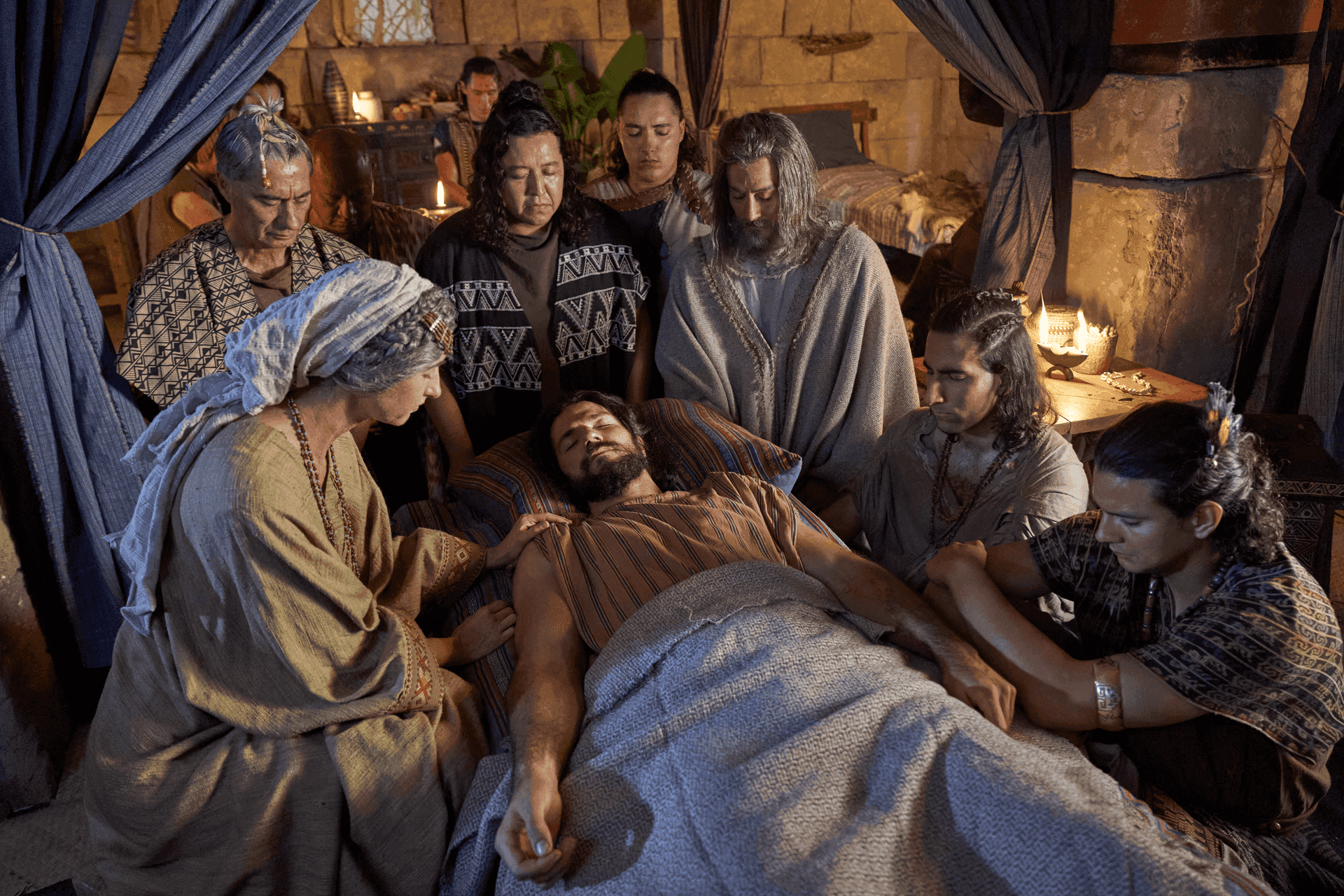
This pattern of healing is also found prominently in the ministry of the sons of Mosiah, who themselves had fallen to the ground and had been converted along with Alma. For example, after Ammon preached to King Lamoni, the king prayed, “O Lord, have mercy; according to thy abundant mercy which thou hast had upon the people of Nephi, have upon me, and my people. And now, when he had said this, he fell unto the earth, as if he were dead” (Alma 18:41–42). After the king remained for two days and two nights in an unconscious state that many assumed was death, Ammon declared the king would arise the next day. He recognized that this was the effect of “the dark veil of unbelief … being cast away from his mind” (Alma 19:6).14 Lamoni awoke as Ammon predicted, declaring, “I have seen my Redeemer; and he shall come forth, and be born of a woman, and he shall redeem all mankind who believe on his name” (Alma 19:13).
This experience caused many Lamanites to fall to the earth as if dead and to receive a spiritual healing as Lamoni had. At this time, Ammon also fell to the earth in an unconscious state, a detail which may seem odd to modern readers. However, it would have fit in perfectly with Ammon’s role as a curandero. As noted by Lipp, “the ability to cure illnesses of increasing severity” becomes greater each time the healer falls unconscious and recovers.15 Hence, “rather than being viewed as a sign of physical weakness or perhaps a case of spiritual hypersensitivity,” this and other instances of falling unconscious “would actually have imbued him with more spiritual potency as a holy man.”16
A final account comes from the conversion of Lamoni’s father. After being taught by Aaron and his brethren, Lamoni’s father converted to the Lord, declaring, “I will give away all my sins to know [God], and that I may be raised from the dead, and be saved at the last day.” Immediately after this, the king “was struck as if he were dead” (Alma 22:18). Much like the experience of Lamoni and his household, Aaron “put forth his hand and raised the king from the earth, and said unto him: Stand. And he stood upon his feet, receiving his strength” (Alma 22:22). This again was done in front of many witnesses, leading to mass conversions.
Conclusion
Some who are skeptical of the Book of Mormon’s ancient origins assume that Alma’s conversion experience is merely a copycat of the Apostle Paul’s experience on the road to Damascus or that the motif of people falling unconscious to the earth is a reflection of behavior at nineteenth-century revival camps. Yet the analysis offered by Wright illustrates that cases of falling to the earth as if dead, which are then followed by a miraculous healing, are actually more similar to experiences found in Indigenous American contexts.
At first glance, this unique pattern of conversion and healing may seem odd or inappropriate. Yet it actually makes sense once one considers that the Lord often communicates to people within their own cultural contexts. As the prophet Nephi declared, “the Lord God giveth light unto the understanding; for he speaketh unto men according to their language, unto their understanding” (2 Nephi 31:3).
One might also consider the various ways that this cultural backdrop is compatible with essential gospel teachings and symbolism. Those who fell unconscious in the Book of Mormon appeared to be dead. Yet, in each case, they miraculously arose, sometimes after a two- or three-day period (Alma 19:5–11; Alma 36:10). These healings therefore appropriately typify the death and resurrection of Christ himself, while also capturing the essence of being born again. Having been converted to Jesus Christ, those who underwent these experiences were then able to help others come unto Christ. By reappropriating an already existing cultural framework, the Lord was able to convey powerful and meaningful truths about the gospel of Jesus Christ.
Many biblical scholars have noticed similar tendencies in biblical texts. Rather than revealing something completely new and foreign to his people, the Lord apparently chose to embed and refine his truths within an already established ancient Near Eastern or Mediterranean cultural context. It appears that the accounts of healing and conversion in the Book of Mormon accomplished something very similar, just in a New World setting.17 Since Joseph Smith likely wouldn’t have been familiar with the nuanced expectations among Native American cultures, these accounts strengthen the case for the Book of Mormon’s historical authenticity.
Mark Alan Wright, “Nephite Daykeepers: Ritual Specialists in Mesoamerica and the Book of Mormon,” in Ancient Temple Worship: Proceedings of the Expound Symposium, 14 May 2011, ed. Matthew B. Brown, Jeffrey M. Bradshaw, Stephen D. Ricks, and John S. Thompson (Interpreter Foundation and Eborn Books, 2014), 243–257.
Mark Alan Wright, “‘According to Their Language, unto Their Understanding’: The Cultural Context of Hierophanies and Theophanies in Latter-day Saint Canon,” Studies in the Bible and Antiquity 3 (2011): 51–65.
Mosiah 27:18–19
Alma 18–19
Alma 22:17–22
Alma 15:3–12
- 1. For Alma and the sons of Mosiah, see Mosiah 27:18–19; for Lamoni and Ammon, see Alma 18–19; for Lamoni’s father and Aaron, see Alma 22:17–22, for Zeezrom, see Alma 15:3–12. In the account of Jesus’s visit to the Americas in 3 Nephi, Jesus healed many people, and the multitudes bowed down before Him. While not necessarily linked, this does provide an interesting parallel. See Matthew L. Bowen, “‘They Came Forth and Fell Down and Partook of the Fruit of the Tree’: Proskynesis in 3 Nephi 11:12–19 and 17:9–10 and Its Significance,” in Third Nephi: An Incomparable Scripture, ed. Andrew C. Skinner and Gaye Strathearn (Deseret Book and Neal A. Maxwell Institute for Religious Scholarship, 2012), 107–130.
- 2. Mark Alan Wright, “Nephite Daykeepers: Ritual Specialists in Mesoamerica and the Book of Mormon,” in Ancient Temple Worship: Proceedings of the Expound Symposium, 14 May 2011, ed. Matthew B. Brown, Jeffrey M. Bradshaw, Stephen D. Ricks, and John S. Thompson (Interpreter Foundation and Eborn Books, 2014), 248.
- 3. Frank J. Lipp, “A Comparative Analysis of Southern Mexican and Guatemalan Shamans,” in Mesoamerican Healers, ed. Brad R. Huber and Alan R. Sandstrom (University of Texas Press, 2001), 103–104.
- 4. Wright, “Nephite Daykeepers,” 249.
- 5. Lipp, “Comparative Analysis,” 103. See also Wright, “Nephite Daykeepers,” 249.
- 6. Lipp, “Comparative Analysis,” 103.
- 7. Wright, “Nephite Daykeepers,” 249 notes: “It would be a mistake to place physical and spiritual healing in separate categories; the two concepts are equated in scripture and in the ancient mind.” Wright draws upon passages such as 3 Nephi 18:32, which states that Jesus desires all to “return and repent, and come unto me with full purpose of heart, and I shall heal them.” For Alma’s accounts of his conversion, see Scripture Central, “Book of Mormon Evidence: Alma’s Consistent Conversion Accounts,” Evidence 52 (September 19, 2020); S. Kent Brown, “Alma’s Conversion: Reminiscences in His Sermons,” in The Book of Mormon: Alma, The Testimony of the Word, ed. Monte S. Nyman and Charles D. Tate Jr. (Religious Studies Center, Brigham Young University, 1992), 141–156.
- 8. Wright, “Nephite Daykeepers,” 250.
- 9. Alma noted that “for the space of three days and three nights that I could not open my mouth, neither had I the use of my limbs” (Alma 36:10). This experience of a divine intervention followed by three days of some physical infirmity has often been compared to Saul’s experience on the road to Damascus. However, significant variations between the two stories demonstrate that Alma’s experience was targeted to him given his New World understanding. As noted by Wright, “the New Testament account of Saul’s conversion experience on the road to Damascus (Acts 9:3–9) may bear superficial similarities to Alma’s experience in the Book of Mormon, but there is a significant difference. We have no record that Saul had a near-death experience in the sense that his soul embarked on a spirit journey while his body lay suffering (as did Alma and Lamoni), which is a defining factor in Mesoamerican shamanic calls.” Wright, “Nephite Daykeepers,” 251.
- 10. See Scripture Central, “Book of Mormon Evidence: Lehi’s Calling (Overview),” Evidence 345 (June 7, 2022); Scripture Central, “Book of Mormon Evidence: Alma’s Prophetic Calling,” Evidence 346 (June 7, 2022).
- 11. Mark Alan Wright, “‘According to Their Language, unto Their Understanding’: The Cultural Context of Hierophanies and Theophanies in Latter-day Saint Canon,” Studies in the Bible and Antiquity 3 (2011): 61.
- 12. Wright, “According to Their Language,” 62.
- 13. Other hints that Alma was spiritually recognized as a Mesoamerican healer can be found in his knowledge of the cosmos in Alma 30:44 and the observation that plants were prepared by the Lord for the healing of the people in Alma 46:40. Oftentimes, ritual healers in Mesoamerica “tracked the cycles of planets, had their own set of constellations, and were even able to predict eclipses.” They also “believe medicinal plants were provided by the gods for the purpose of healing.” Wright, “Nephite Daykeepers,” 247, 253.
- 14. Wright, “Nephite Daykeepers,” 251, observes, “The similarity between Lamoni’s and Alma’s experiences demonstrates the larger cultural language that was shared by Nephites and Lamanites in their ancient Mesoamerican setting.”
- 15. Lipp, “Comparative Analysis,” 104. This detail stands true today for healers among the Tzotzil Maya of Chamula.
- 16. Wright, “Nephite Daykeepers,” 252.
- 17. See Scripture Central, “Why Does the Lord Speak to Men ‘according to Their Language’? (2 Nephi 31:3),” KnoWhy 258 (January 6, 2017).