Evidence #557 | September 3, 2026
Book of Moses Evidence: Enoch the Warrior
Post contributed by
Scripture Central
Abstract
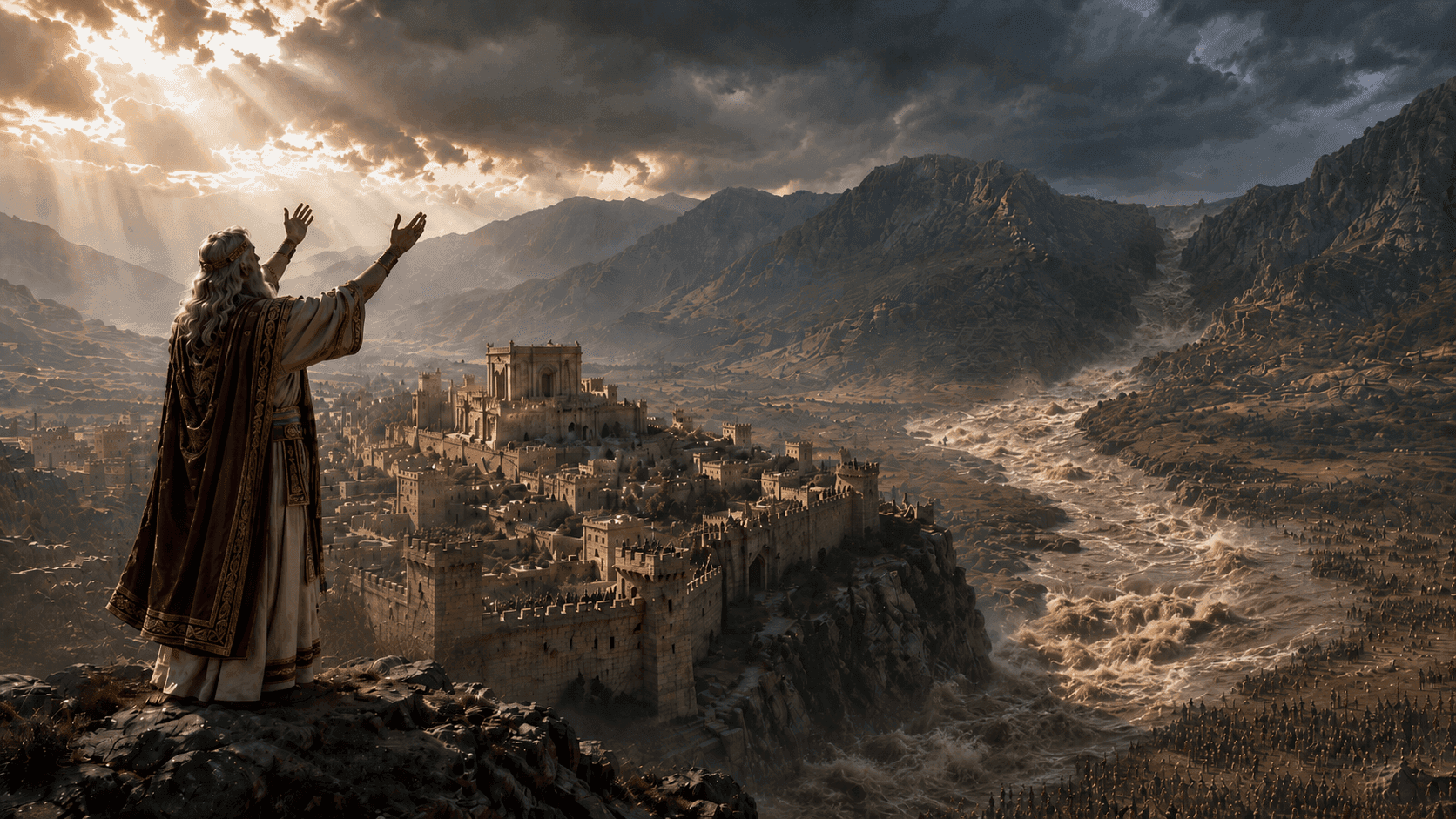
The Book of Moses describes Enoch and his people in military contexts that have parallels in extrabiblical sources.When Enoch first began to preach among the people in the Book of Moses, it is reported that “all men were offended because of him” (Moses 6:37). In the next chapter, this antipathy escalated into violence, as the wicked sought to destroy Enoch and his people through military conflict. Nevertheless, Enoch was able to command the very elements of nature to thwart such efforts:
And so great was the faith of Enoch that he led the people of God, and their enemies came to battle against them; and he spake the word of the Lord, and the earth trembled, and the mountains fled, even according to his command; and the rivers of water were turned out of their course; and the roar of the lions was heard out of the wilderness; and all nations feared greatly, so powerful was the word of Enoch, and so great was the power of the language which God had given him. There also came up a land out of the depth of the sea, and so great was the fear of the enemies of the people of God, that they fled and stood afar off and went upon the land which came up out of the depth of the sea. And the giants of the land, also, stood afar off; and there went forth a curse upon all people that fought against God; And from that time forth there were wars and bloodshed among them; but the Lord came and dwelt with his people, and they dwelt in righteousness. The fear of the Lord was upon all nations, so great was the glory of the Lord, which was upon his people. And the Lord blessed the land, and they were blessed upon the mountains, and upon the high places, and did flourish. (Moses 7:13–17)
It isn’t clear whether the Lord’s supernatural aid entirely removed the need for Enoch and his people to fight, or if the divine intervention simply supplemented or amplified their efforts to repel hostile forces. What is clear is that, in one or more military contexts, Enoch used the divine power of speech to overcome the enemies of his people.1 As described in JST Genesis 14:31, those with the faith of Enoch will be given power to “put at defiance the armies of nations.”
Extrabiblical Sources
These details are validated to varying degrees by extrabiblical sources. One potentially relevant ancient text is the Book of Giants. In the Aramaic version, a mighty figure—apparently one of the giants—laments that he was unable to prevail in battle against mysterious adversaries who “reside in [heav]en” and “dwell in the holy places.” In one passage he declares, “I made war against them, but [I was] not [strong enough, and] I was [not] able to prevail against them, because my adversaries … dwell [in heave]n, and they reside in holy places.”2 As interpreted by Jeffrey Bradshaw, this passage describes the giants as suffering “defeat in a great battle with Enoch and his people,”3 meaning those who dwelt in the “city of Holiness” and who were eventually “taken up into heaven” (Moses 7:19–21). In light of this parallel, it is interesting that a passage in the Jewish Zohar describes Metatron (Enoch in his angelic form) as “the leader over all the celestial armies.”4
Other sources describe Enoch as receiving some type of divine protection from his enemies. In a Mandaean account, a divine being tells an Enoch figure, “Fear not the wicked, … it shall not be granted to them to do you any harm.”5 Likewise, an Islamic source states that “God assigned for Idrīs [i.e., Enoch] angels to protect him, and when Iblis [Satan] and some of those who were with him from his forces came (to do Idrīs harm), they kept them from harming him.”6
Some Islamic sources describe Idris (the Islamic name associated with Enoch) in an even more explicit military capacity. One such text states that “Idrīs (upon whom be peace!) was the first to take up weapons and to undertake a jihād for the path of God Most High, and he fought with the descendants of Cain.”7 The detail about the posterity of Cain is notable because his seed is mentioned in Moses 7:22, a passage that shortly follows the description of Enoch and his people defeating their enemies.8
Conclusion
Enoch isn’t fully depicted as a military leader in the Book of Moses, at least not in the traditional sense. He is never portrayed defeating his enemies through strategy nor by displaying his own physical prowess or skill in battle. Nevertheless, by drawing upon God’s divine power, he does protect his people and repel enemy forces in military contexts, which leads to his Zion community becoming an object of fear among nations.
If the account in the Book of Moses were true, one might expect extrabiblical Enochic traditions to reflect these details to some extent. And, indeed, that is what one finds. In the Book of Giants, the wicked are overpowered by a mysterious group of heavenly or angelic beings. In other sources, Enoch is repeatedly described as receiving some type of divine protection from his enemies. And in some Islamic accounts, Enoch is specifically portrayed as a military leader who battles with the seed of Cain. None of these sources would have been plausibly available to Joseph Smith in 1830.
This, of course, does not prove the authenticity of the Book of Moses. These parallels are not specific or unique enough to compel belief, and none of them precisely replicate the details in the Book of Moses. They do, however, constitute several relevant thematic resemblances—some arising in specific parallel contexts—that meaningfully contribute to the cumulative case favoring the authenticity of the Book of Moses.
Jeffrey M. Bradshaw, Enoch and the Gathering of Zion: The Witness of Ancient Texts for Modern Scripture (Interpreter Foundation, with Scripture Central and Eborn Books, 2021), 110–111.
Jeffrey M. Bradshaw, “Moses 6–7 and the Book of Giants: Remarkable Witnesses of Enoch’s Ministry,” Interpreter: A Journal of Latter-day Saint Faith and Scholarship 48 (2021): 95–312.
Bible
JST Genesis 14:30–31
Book of Moses
Moses 6:37
Moses 7:13–17
Moses 7:19–22
- 1. See Scripture Central, “Book of Moses Evidence: Enoch’s Divine Power of Speech,” Evidence 504 (July 23, 2025).
- 2. Loren T. Stuckenbruck, “The Aramaic Book of Giants,” in Old Testament Pseudepigrapha: More Noncanonical Scriptures, vol. 2, ed. James R. Davila and Richard Bauckham (William B. Eerdmans, 2025), 81.
- 3. Jeffrey M. Bradshaw, Enoch and the Gathering of Zion: The Witness of Ancient Texts for Modern Scripture (Interpreter Foundation, with Scripture Central and Eborn Books, 2021), 48. It should be clarified, however, that this is an interpretive overlay. The actual text of the Book of Giants is highly fragmentary and doesn’t specifically mention that Enoch was associated with the group of heavenly or divine beings who thwarted the giants. For other evidence articles that are adjacent to this topic, see Scripture Central, “Book of Moses Evidence: Enoch’s Divine Comfort and Protection,” Evidence 520 (November 21, 2025); Scripture Central, “Book of Moses Evidence: The Roar of Lions,” Evidence 517 (October 22, 2025); Scripture Central, “Book of Moses Evidence: Rivers Turned from Their Course,” Evidence 514 (October 1, 2025).
- 4. Zohar Ḥadash, Terumah fol. 42d (ed. Margaliot); as cited John C. Reeves and Annette Yoshiko Reed, Enoch from Antiquity to the Middle Ages: Sources from Judaism, Christianity, and Islam (Oxford University Press, 2018), 264. The fact that this description is given in the context of “judgment” and “anger” adds to its martial connotations.
- 5. Jacques P. Migne, “Livre D’Adam,” in Dictionnaire des Apocryphes, ou, Collection de tous les livres Apocryphes relatifs a l’Ancien et au Nouveau Testament, ed. Jacques P. Migne, 2 vols (Paris, France: Jacques P. Migne, 1856), 167. This English translation from French was provided by ChatGPT and independently corroborated by Gemini.
- 6. Pseudo-Mas‘ūdī, Akhbār al-zamān wa-min abādat al-hidthān; as cited Reeves and Reed, Enoch from Antiquity to the Middle Ages, 157–158.
- 7. Wahb apud Kisāʾī, Qiṣaṣ al-anbiyāʾ (ed. Eisenberg). Another text states that Idris “was the first to capture some of the offspring of Qabil and to enslave them,” suggesting they were pitted against one another in some type of military contest. See “another (authority) from the people of the Torah” apud Ṭabarī, Taʾrīkh (ed. de Goeje). Both sources are cited in Reeves and Reed, Enoch from Antiquity to the Middle Ages, 163.
- 8. See Scripture Central, “Book of Moses Evidence: The Seed of Cain,” Evidence 548 (June 10, 2026).