Evidence #555 | August 12, 2026
Book of Moses Evidence: Enoch the High Priest
Post contributed by
Scripture Central
Abstract
The Book of Moses strongly suggests—and other modern revelations affirm—that Enoch belonged to a priesthood order perpetuated by Adam and his righteous posterity. Many details surrounding this association are corroborated by extrabiblical sources.As part of an introduction to Adam’s righteous lineage in Moses 6,1 the text declares that “these men began to call upon the name of the Lord.” It is then reported that Adam prophesied that “this same Priesthood, which was in the beginning, shall be in the end of the world also” (Moses 6:4–7).2 The mention of a holy ordinance in Moses 5:59 may further hint at priesthood activities and authority: “And thus all things were confirmed unto Adam, by an holy ordinance, and the Gospel preached, and a decree sent forth, that it should be in the world, until the end thereof.”3 Priesthood imagery also follows the account of Adam’s baptism in Moses 6:67: “And thou art after the order of him who was without beginning of days or end of years, from all eternity to all eternity. Behold, thou art one in me, a son of God; and thus may all become my sons.”4
Because Enoch is identified as a member of Adam’s righteous lineage who was “taught … in all the ways of God” (Moses 6:21, 41),5 one might reasonably assume he received the same priesthood authority that was given to Adam.6 A strong clue supporting this possibility arises from the description of Noah in Moses 8:19: “the Lord ordained Noah after his own order, and commanded him that he should go forth and declare his Gospel unto the children of men, even as it was given unto Enoch.”
Throughout Moses 7, Enoch can be seen as fulfilling the role of a priestly mediator, in the sense that he is concerned about the corruption upon the earth and pleads on its behalf and also for its righteous inhabitants. At one point Enoch petitions the Lord, asking, “When shall the day of the Lord come? When shall the blood of the Righteous be shed, that all they that mourn may be sanctified and have eternal life?” (Moses 7:45). The imagery of shedding blood to achieve atonement was integral to the priestly activities of the Old Testament.
The story of Enoch in Moses 6–7 is also filled with temple themes, which are inherently associated with priesthood orders and activities. These includes references to high places, depictions of heavenly ascent, and the idea that Enoch and his people will meet the earthly Zion community at the “Holy City,” which is further designated as “Zion,” the “New Jerusalem,” and the Lord’s “tabernacle” (Moses 7:62–63).7 Some specific temple-related priesthood ordinances may even be hinted at, such as Enoch being “clothed upon with glory” (Moses 7:3), having his mouth opened and filled by the Lord (Moses 6:32), and his receiving a dual anointing and washing ritual, allowing him to see spiritual things (Moses 6:35).8 As understood by Jeffrey Bradshaw, many details throughout the text “presuppose a detailed understanding of the covenants and sequences of blessings associated with current forms of Latter-day Saint temple worship.”9
Enoch’s association with the priesthood becomes even more pronounced in other passages of Restoration scripture. These affirm that he was not only a high priest but a prominent figure in the antediluvian priesthood order. In JST Genesis 14:27–28, it is reported that Melchizedek—an archetypal priestly figure—was “ordained an high priest after the order of the covenant which God made with Enoch, It being after the order of the Son of God.” Likewise, D&C 76:57 states that those who inherit the celestial kingdom “are priests of the Most High, after the order of Melchizedek, which was after the order of Enoch, which was after the order of the Only Begotten Son. Wherefore, as it is written, they are gods, even the sons of God.”10 According to D&C 107, Enoch was a “high priest” who was “ordained under the hand of Adam” (D&C 107:48, 53). Enoch’s inclusion among a righteous line of priesthood holders is also mentioned in D&C 84:16.11
Hence, what is strongly hinted at in the Book of Moses—i.e., Enoch’s personal connection to priesthood power and authority—is explicitly and repeatedly affirmed in other Restoration texts. This development is significant considering that Enoch’s priestly associations are well-attested in a variety of extrabiblical sources.
Jubilees
The book of Jubilees reports that Enoch was placed in the “land of Eden” and that he “offered the incense which is acceptable before the LORD in the evening (at) the holy place on Mount Qater” (Jubilees 4:25).12 This description mirrors the priestly service of burning incense performed by later Israelite priests in the inner precincts of the temple or tabernacle. “No explanation is provided,” opines Philip Davis, “but the role of incense in the cultic laws of the Pentateuch (Exod. 30:7–10; Num. 16:6–48) encourages the inference that Enoch is here said to be performing an ongoing activity of intercession and atonement.”13 As assessed by Philip Alexander, “Enoch in Jubilees in the second century B.C.E. is a high priest.”14
1 Enoch
Much more prominent, however, is Enoch’s role as a priest or servant of God in the heavenly realms. Hints of this imagery appear in portions of 1 Enoch 14–15, where Enoch receives his prophetic calling and is shown a vision of a heavenly sanctuary.15 “Several indications” within this narrative, writes George Nickelsburg, suggest “that the author is describing a tour through a heavenly temple.”16 This view is shared by other scholars, who see the angels in the scene as counterparts to earthly priests.17 David Halperin concludes, “The high priest must be Enoch himself, who appears in the celestial Holy of Holies to procure forgiveness for holy beings.”18
Enoch is similarly taken up to a “high tower” in 1 Enoch 87:3, from which he sees a vision of world history. Andrei Orlov understands this as additional evidence of Enoch’s priestly role, seeing that it typologically situates him “in the heavenly sanctuary” throughout the rest of the Animal Apocalypse (a subsection within 1 Enoch).19
2 Enoch
As for 2 Enoch, the prophet undergoes a remarkable transformation when he is clothed with glorious garments and anointed with oil:20
And the LORD said to Michael, “Go, and extract Enoch from [his] earthly clothing. And anoint him with my delightful oil, and put him into the clothes of my glory.” And so Michael did, just as the LORD had said to him. He anointed me and he clothed me. And the appearance of that oil is greater than the greatest light, and its ointment is like sweet dew, and its fragrance myrrh; and it is like the rays of the glittering sun. And I looked at myself, and I had become like one of his glorious ones, and there was no observable difference. (2 Enoch 22:8–10)21
Several scholars have observed that Enoch’s “anointing with shining oil and the transformation of his clothing into the luminous garments during his angelic metamorphosis appear to resemble the priestly investiture,” as described in several Old Testament passages.22 Endowed Latter-day Saints may further recognize priesthood connections between this scene and restored temple ordinances.23
In relation to his glorious transformation, Enoch is repeatedly described in 2 Enoch as one who was able to stand before the “face” of the Lord.24 This language signals that Enoch stood in close proximity to God in the inner precincts of the heavenly temple, analogous to a mortal priest’s privileged access to sacred space. Further support for the temple and priestly connotations of this “face” imagery comes from its regular use in connection to altars and ritual sacrifices among Enoch’s posterity.25
In contrast to Enoch’s brief tour of the holy temple in 1 Enoch 14–15, Orlov notes that “in 2 Enoch the patriarch is depicted not simply as a visitor who has only temporary access to the divine Presence but as an angel permanently installed in the office of the sar happanim [Prince of the Divine Presence/Face].”26 Adjacent to his role as a priestly figure, Enoch also functioned in a liturgical capacity as the director of the heavenly choir that offered up praises before the “face of the Lord” (2 Enoch 18:8–9).27
Enoch is sometimes designated as a “servant” of the Lord or the “servant of the Face.”28 Concerning the angel Metatron (Enoch in his glorified state), Philip Alexander explains, “One of Meṭaṭron’s most distinctive titles is Na‘ar. Originally this was used in the sense of ‘servant’ and it referred to Meṭaṭron’s role as the high priest of the heavenly sanctuary.”29 This connotation may be somewhat reflected in Enoch’s prophetic calling in Moses 6:31, in which he asks the Lord, “wherefore am I thy servant?”30
Another temple theme arises in 2 Enoch 67–69, in which the patriarch’s descendants erect an altar at a site called Ahuzan, where Enoch had ascended into heaven. Because some scholars have seen the name of this location as an allusion to Jerusalem and its temple, “the place of Enoch’s final departure might attest to the peculiar role of the ascended hero in relation to the heavenly counterpart of this earthly structure.”31
The final chapters of 2 Enoch have particularly pronounced priesthood associations. Orlov explains,
It is also significant that a large portion of the apocalypse (Chapters 68–73) is dedicated to the descriptions of the priestly duties of [Enoch’s] descendants, including his son Methuselah and his grandgrandson Nir, both of whom are depicted as priests offering animal sacrifices on the altar. Moreover, in 2 Enoch 59 the patriarch [i.e., Enoch] is portrayed as the one who delivers sacrificial instruction to his children. This transmission of the sacerdotal knowledge does not appear to be accidental since in 2 Enoch 71:32 the seventh antediluvian hero [i.e., Enoch] appears in the line of the great priests preceding Methuselah and Nir.32
Perhaps the most intriguing feature of these chapters, however, is the account of the birth of Melchizedek, who was miraculously conceived by the wife of Nir (Noah’s brother) and then translated into paradise.33 Within the scope of the narrative, Melchizedek can be understood as Enoch’s final and most conspicuous priestly successor, a development that is nowhere hinted at in the Bible but resonates strongly with JST Genesis 14:27–28 and D&C 76:57.34 This notable relationship between Enoch and Melchizedek has not been overlooked by scholars, who see them both as significant priestly mediators.35
3 Enoch
Enoch’s priestly associations are further developed in the book of 3 Enoch. The account is fundamentally about Metatron (Enoch in his angelic form) guiding a priestly rabbi named Ishmael through the heavenly mysteries. “The priestly features of this visionary [i.e., Rabbi Ishmael],” writes Orlov, “might not only reflect the heavenly priesthood of Metatron, but also allude to the former priestly duties of the patriarch Enoch known from 1 Enoch and Jubilees, since some scholars observe that ‘3 Enoch presents a significant parallelism between the ascension of Ishmael and the ascension of Enoch.’”36 This mirrors Enoch’s ability to help other members of his Zion community attain heaven, as described throughout Moses 7 and in JST Genesis 14:30–34.37 As Hugh Nibley once remarked, “Enoch is the great initiate who becomes the great initiator.”38
3 Enoch is also filled with various aspects of temple imagery. This association is made explicit in 3 Enoch 15b:1, where the “heavenly tabernacle” is directly referenced:
Metatron is Prince over all princes, and stands before him who is exalted above all gods. He goes beneath the throne of glory, where he has a great heavenly tabernacle of light, and brings out the deafening fire, and puts it in the ears of the holy creatures, so that they should not hear the sound of the utterance that issues from the mouth of the Almighty.39
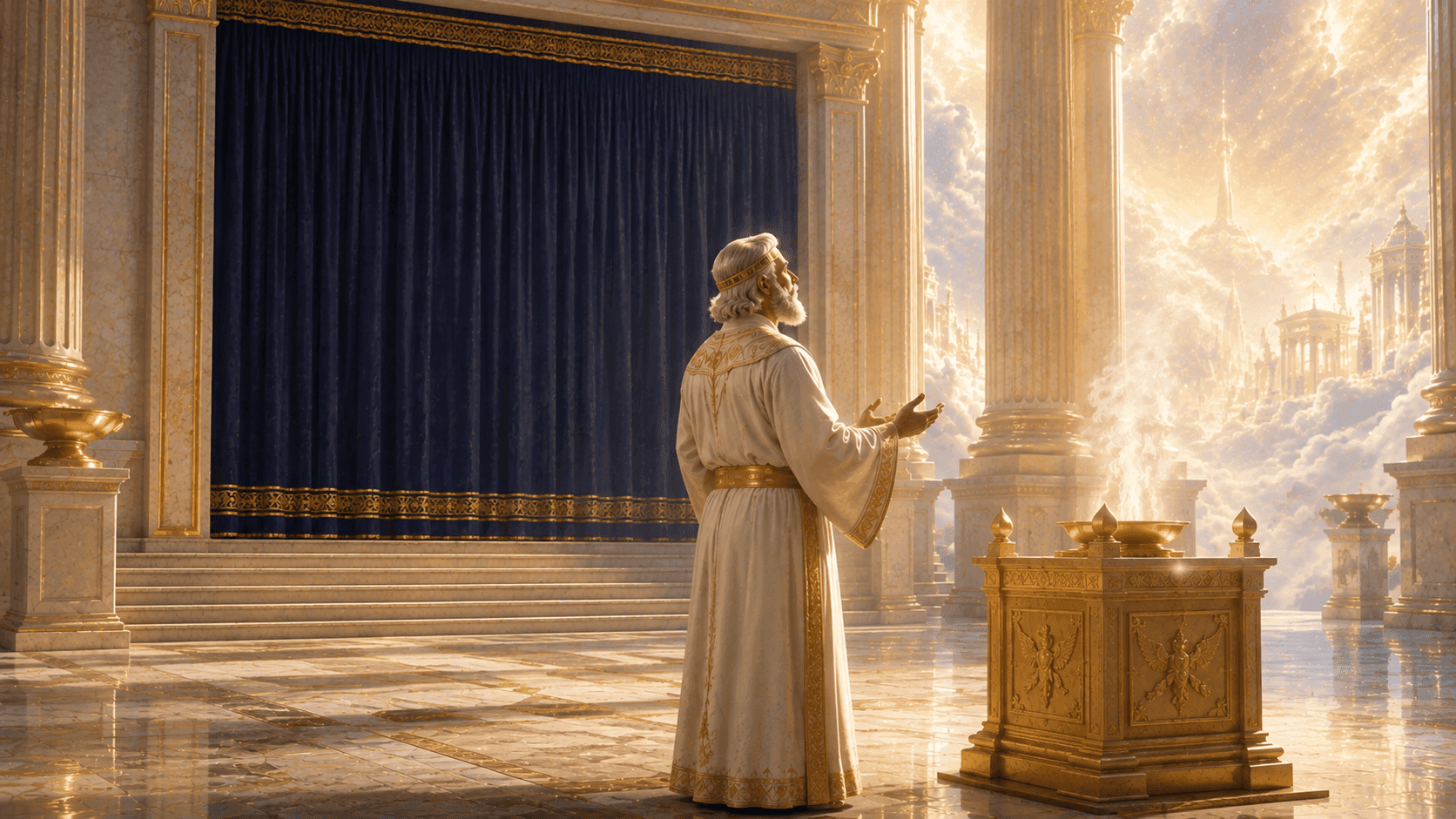
The “throne of glory” corresponds well with the mercy seat in the Holy of Holies in the mortal tabernacle and temple.40 Elsewhere in the text, curtain imagery is also introduced: “Come and I will show you the curtain of the Omnipresent One, which is spread before the Holy One” (3 Enoch 45:1).41 Alexander writes, “This curtain is the heavenly counterpart of the Veil which divided the Holy Place from the Holy of Holies in the earthly Tabernacle and Temple.”42 According to Orlov, such passages stress “Enoch-Metatron’s role as the celestial high priest, since he approaches the realm where ordinary creatures, angelic or human, are not allowed to enter. This realm of the immediate presence of the Deity, the Holy of Holies, is situated behind the veil represented by heavenly (פרגוד) or terrestrial (פרכת) curtains.”43
What was printed on this curtain is also of interest, as it contained “all the generations of the world and all their deeds, whether done or to be done, till the last generation” (3 Enoch 45:1–2).44 In particular, the curtain listed the names of leaders of the world—past, present, and future—in their various capacities. This is especially interesting in light of several Restoration texts (Moses 5:10, 6:5–8; and D&C 107:40–57) which connect Adam’s prophecy of all future generations with the key concepts of heavenly records and a righteous priesthood lineage.45
Additional Jewish Sources
Other Jewish texts further connect Enoch-Metatron to priesthood and temple imagery. According to a source in Numbers Rabbah,
When the Holy One blessed be He said to Israel to erect the Tabernacle, he intimated to the ministering angels that they too should craft a Tabernacle. When the one below was erected, the one above was erected. That is the Tabernacle of the ministering angel Metatron, in which he sacrifices the souls of the righteous to atone for Israel in the days of their exile.46
As understood by Orlov, “This reference might allude to the imagery often found in early Enochic materials which refer to the daily sacrifice of the angelic hosts bathing themselves in the river of fire streaming beneath the Throne of Glory, the exact location of the tabernacle of the Youth [i.e. Metatron].”47
A related connection between Metatron and the tabernacle is made in the Jewish Zohar concerning the vision shown to Moses on Mount Sinai: “From this we see that the Holy One, blessed be He, actually gave Moses all the arrangements and all the shapes of the Tabernacle, each in its appropriate manner, and that he saw Metatron ministering to the High Priest within it.”48 Metatron’s association with the high priesthood is also made explicit in the Cairo Genizah:I adjure you [Metatron], more beloved and dear than all heavenly beings, [Faithful servant] of the God of Israel, the High Priest (כהן גדול), chief of [the priests] (ראש הכהנים), you who poss[ess seven]ty names; and whose name[is like your Master’s] … Great Prince, who is appointed over the great princes, who is the head of all the camps.49
Potential 19th-Century Sources
The sparse information about Enoch in the Bible says nothing specific about his priestly status. That doesn’t mean, however, that Joseph Smith could not have inferred this association. After all, some scriptural passages depict Adam and his righteous posterity as offering sacrifices, a significant priestly responsibility (Genesis 4:3–5; 8:20; Hebrews 11:4). When considered alongside the fact that Enoch was viewed as a particularly righteous prophet and patriarch (Genesis 5:24; Hebrews 11:5; Jude 1:14), this opens the door to concluding that he may also have been a priest.
Indeed, some prominent modern religious thinkers reached that very conclusion. Martin Luther, for instance, viewed Adam and Seth as high priests and described Enoch as “the greatest prophet and high priest of his generation.”50 Matthew Henry’s commentary on Genesis 5 offers a similar understanding. Noticing that the phrase “walking before God” sometimes has priestly connotations in biblical texts (1 Samuel 2:30, 35; Zechariah 3:7), Henry gives the following conjecture: “Enoch, it should seem, was a priest of the most high God.”51
While it appears that Luther’s commentary would not have been available in English during Smith’s lifetime, Henry’s work, first published in the early 1700s, was quite popular and therefore reasonably accessible.52 Perhaps similar sources exist and remain to be discovered, but these demonstrate that such speculations may have been present in Smith’s environment.53 Even if he never stumbled across such sources, it is possible that he might have reached a similar conclusion from his own reading of the Bible.
Conclusion
Those skeptical of Joseph Smith’s prophetic calling may naturally assume that Enoch’s priestly associations in the Book of Moses derive from relevant biblical passages or some other 19th-century source (or sources). And, at least when approached at a general level of analysis, that explanation is not implausible, as just outlined.
Joseph Smith’s revelations, however, do more than merely describe Enoch as a prominent high priest. They also link him to an array of specific priestly images and connotations that are separately corroborated in various extrabiblical sources. Examples include Enoch’s association with (1) the temple or tabernacle, (2) divine face imagery, (3) servant language, (4) a clothing ritual, (5) an anointing ritual, (6) the initiation of others into the heavenly mysteries, (7) God’s throne, (8) the celestial curtain, (9) God’s foreknowledge of priestly rulers connected with heavenly records, and (10) the figure of Melchizedek, who is depicted as a translated being.
When viewed together, these and other elements form a substantial complex of priesthood and temple motifs that are more difficult for an environmental derivation hypothesis to fully explain. Whereas one or two items might plausibly be guessed or borrowed from available 19th-century sources, the entire suite of priesthood themes seems less likely to come from Smith’s environment or ingenuity, especially when their nuanced relationships with extrabiblical sources are carefully considered.54
In summary, Enoch’s priestly associations in the Book of Moses and other Restoration texts form a unique blending of details that also arise in various ancient and medieval traditions. They therefore support the authenticity of the Book of Moses and, by extension, the validity of Joseph Smith’s prophetic calling.
Jeffrey M. Bradshaw and David J. Larsen, In God’s Image and Likeness 2: Enoch, Noah, and the Tower of Babel (The Interpreter Foundation and Eborn Books, 2014), 82–83.
Jeffrey M. Bradshaw and David J. Larsen, In God’s Image and Likeness 1: Creation, Fall, and the Story of Adam and Eve (The Interpreter Foundation and Eborn Books, 2014), 480.
Hugh Nibley, Enoch the Prophet, The Collected Works of Hugh Nibley, Volume 2 (FARMS, 1986), 19–65.
Bible
Genesis 1:14–19
Genesis 4:3–5
Genesis 5:21–24
Genesis 5:24
Genesis 8:20
JST Genesis 14:27–28
JST Genesis 14:30–34
JST Genesis 14:34
Exodus 25–31
Exodus 30:22–23
1 Samuel 2:30, 35
Psalm 133:2–3
Zechariah 3
Zechariah 3:7
Hebrews 11:4
Hebrews 11:5
Jude 1:14
Book of Mormon
Alma 13:16
Book of Moses
Moses 5:7
Moses 5:10
Moses 5:59
Moses 6:5–8
Moses 6:7
Moses 6:21
Moses 6:31
Moses 6:41
Moses 6:67
Moses 7:62–63
Moses 8:18
Moses 8:19
Book of Abraham
Abraham 3:23
Doctrine and Covenants
Doctrine and Covenants 76:57
Doctrine and Covenants 84:16
Doctrine and Covenants 107:40–57
- 1. This stands in contrast to Moses 5, which mostly focuses on the wickedness of Cain and the establishment of secret combinations among Adam’s posterity. See Scripture Central, “Book of Moses Evidence: Forbidden Knowledge and Secret Combinations,” Evidence 532 (February 11, 2026).
- 2. Scripture Central, “Book of Moses Evidence: Adam’s Prophecy,” Evidence 508 (August 20, 2025).
- 3. Notice that this passage, just like Moses 6:7, is also concerned with what would be preserved at the end of the world.
- 4. Another indication of a priesthood order can be seen in the animal sacrifices offered up by Adam and Eve, who were told by an angel, “This thing is a similitude of the sacrifice of the Only Begotten of the Father, which is full of grace and truth” (Moses 5:7). Especially when correlated with Alma 13:16, the description of this ordinance has strong priesthood overtones: “Now these ordinances were given after this manner, that thereby the people might look forward on the Son of God.” There is also evidence that Adam and Eve’s activities in Eden had priesthood significance. See, for example, Alex Douglas, “The Garden of Eden, the Ancient Temple, and Receiving a New Name,” in Ascending the Mountain of the Lord: Temple, Praise, and Worship in the Old Testament (2013 Sperry Symposium), ed. Jeffrey R. Chadwick, Matthew J. Grey, and David Rolph Seely (BYU Religious Studies Center and Deseret Book, 2013), 36–48; Jeffrey M. Bradshaw, “The Tree of Knowledge as the Veil of the Sanctuary,” in Ascending the Mountain of the Lord, 49–65; Scripture Central, “The Garden of Eden as a Model for the Temple in Israel and Old Babylon,” Book of Moses Essay 55 (May 14, 2021).
- 5. See Scripture Central, “Book of Moses Evidence: Enoch, a Student of Righteousness,” Evidence 483 (February 26, 2025).
- 6. See also Moses 6:22–23.
- 7. See Scripture Central, “Book of Moses Evidence: High and Lifted Up,” Evidence 551 (July 1, 2026).
- 8. See Scripture Central, “Book of Moses Evidence: Enoch Clothed with Glory,” Evidence 500 (June 25, 2025); Scripture Central, “Book of Moses Evidence: Enoch’s Anointing,” Evidence 502 (July 9, 2025); Scripture Central, “Book of Moses Evidence: Enoch’s Divine Power of Speech,” Evidence 504 (July 23, 2025).
- 9. Jeffrey M. Bradshaw, “The Book of Moses as a Temple Text,” Interpreter: A Journal of Latter-day Saint Faith and Scholarship 49 (2021): 63–112.
- 10. This passage connects priesthood with divine sonship in a way that is very similar to Moses 6:67.
- 11. See also Abraham 1:2–3: “I became a rightful heir, a High Priest, holding the right belonging to the fathers. It was conferred upon me from the fathers; it came down from the fathers, from the beginning of time, yea, even from the beginning, or before the foundation of the earth, down to the present time, even the right of the firstborn, or the first man, who is Adam, or first father, through the fathers unto me.”
- 12. Translation by O. S. Wintermute, “Jubilees,” in The Old Testament Pseudepigrapha, 2 vols., ed. James H. Charlesworth (Doubleday, 1983–1985), 2:63.
- 13. Philip G. Davis, “Divine Agents, Mediators, and New Testament Christology,” The Journal of Theological Studies 45, no. 2 (October 1994): 496.
- 14. Philip S. Alexander, “From Son of Adam to Second God: Transformations of the Biblical Enoch,” in Biblical Figures Outside the Bible, ed. Michael E. Stone and Theodore A. Bergren (Trinity Press International, 1998), 107.
- 15. For Enoch’s prophetic calling in the Book of Moses, see Scripture Central, “Book of Moses Evidence: Enoch’s Prophetic Commission,” Evidence 485 (March 12, 2025).
- 16. George W. E. Nickelsburg and James C. VanderKam, 1 Enoch 1: A Commentary on the Book of 1 Enoch Chapters 1–36, 81–108, ed. Klaus Baltzer (Fortress Press, 2012), 256; emphasis in original.
- 17. See Andrei A. Orlov, The Enoch-Metatron Tradition, Texts and Studies in Ancient Judaism 107 (Mohr Siebeck, 2005), 72.
- 18. David J. Halperin, The Faces of the Chariot: Early Jewish Responses to Ezekiel’s Vision (Mohr/Siebeck, 1988), 81–82; as cited in Orlov, The Enoch-Metatron Tradition, 172–173.
- 19. Orlov, The Enoch-Metatron Tradition, 75.
- 20. See Scripture Central, “Book of Moses Evidence: Enoch Clothed with Glory,” Evidence 500 (June 25, 2025); Scripture Central, “Book of Moses Evidence: Enoch’s Anointing,” Evidence 502 (July 9, 2025).
- 21. Translation by Frances I. Anderson, “2 (Slavonic Apocalypse of) Enoch,” in The Old Testament Pseudepigrapha, 1:138. Here and elsewhere throughout this article, all references and quotations to 2 Enoch are from Anderson and reflect the long recension (J).
- 22. Orlov, The Enoch-Metatron Tradition, 201. Expounding on this topic, Crispin Fletcher-Louis writes, “Enoch’s transformation in 2 Enoch is greatly indebted to priestly practice and its understanding of investiture. The myrrh fragrance of the oil of Enoch’s anointing recalls the sacred oil of anointing prescribed by Moses for the tabernacle in Exodus 30:22–23. The comparison of the oil with sweet dew is perhaps a reflection of Psalm 133:2–3 where there is a parallelism between the oil running down the head of Aaron and the dew of Mount Hermon. The reference to the glittering rays of the sun is yet one more witness to the theme of priestly luminescence. The specific comparison of the oil of anointing with the sun’s rays is ultimately dependent on the priestly tradition within the Pentateuch since there the oil of anointing is placed in God’s fourth speech to Moses in Exodus 25–31 as a parallel within the Tabernacle instructions to the creation of the sun, moon and stars on the fourth day of creation (Genesis 1:14–19). In general terms Enoch’s investiture is indebted to the scene in Zechariah 3 where the high priest’s old clothes are removed and replaced with new ones.” Crispin H. T. Fletcher-Louis, All the Glory of Adam: Liturgical Anthropology in the Dead Sea Scrolls, Studies on the Texts of the Desert of Judah 42 (Brill, 2002), 231.
- 23. See Jeffrey M. Bradshaw, Freemasonry and the Origins of the Latter-day Saint Temple Ordinances (The Interpreter Foundation and Eborn Books, 2022), 116–126. For an analysis of ascension themes throughout the Book of Moses, see Jeffrey M. Bradshaw, “The Book of Moses as a Temple Text,” in Tracing Ancient Threads in the Book of Moses: Inspired Origins, Temple Contexts, and Literary Qualities, ed. Jeffrey M. Bradshaw, David Rolph Seely, John W. Welch, and Scott A. Gordon (The Interpreter Foundation and Eborn Books, 2021), 421–468.
- 24. See Scripture Central, “Book of Moses Evidence: Enoch Stood Before God’s Face,” Evidence 519 (November 5, 2025).
- 25. See 2 Enoch 62:1; 68:6; 69:1, 5, 10, 13–19; 70:1–2. A similar association may be present in the later Christian work known as the Cave of Treasures. According to this source, before his passing, Jared instructed Enoch, “And you, my son Enoch, do not leave Adam’s body but minister in front of God purely and in holiness all the days of your life.” Translation by Alexander Toepel, “The Cave of Treasures: A New Translation and Introduction,” in Old Testament Pseudepigrapha: More Noncanonical Scriptures, vol. 1, ed. Richard Bauckham, James R. Davila, and Alexander Panayotov (Eerdmans, 2013), 550. It should further be noted that, in this text, Adam is described as a “king, priest, and prophet” (p. 543). It therefore seems likely that his posterity was assumed to perform priestly functions before the Lord in their offering of animal sacrifices.
- 26. Orlov, The Enoch-Metatron Tradition, 156.
- 27. See Orlov, The Enoch-Metatron Tradition, 117–120.
- 28. See Orlov, The Enoch-Metatron Tradition, 153–156.
- 29. Philip Alexander, “3 (Hebrew Apocalypse of) Enoch,” in The Old Testament Pseudepigrapha, 1:258.
- 30. See Scripture Central, “Book of Moses Evidence: Enoch’s Prophetic Commission,” Evidence 485 (March 12, 2025); Scripture Central, “Book of Moses Evidence: Enoch the Lad,” Evidence 480 (February 6, 2025).
- 31. Orlov, The Enoch-Metatron Tradition, 202.
- 32. Orlov, The Enoch-Metatron Tradition, 202.
- 33. Apparently, his escape into heaven was intended to allow Melchizedek (or perhaps a typological manifestation of his identity) to reappear in later generations. The text, however, is somewhat ambiguous on this point (see 2 Enoch 72:29–37). In any case, these details resonate with the theme of Melchizedek and his people being translated in JST Genesis 14:34.
- 34. According to Andrei Orlov, “Melchizedek Legend of 2 (Slavonic) Enoch,” Journal for the Study of Judaism 31, no. 1 (2000): 28, “2 Enoch presents Melchizedek as a continuation of the priestly line from Methuselah, son of Enoch, directly to the second son of Lamech, Nir (brother of Noah), and on to Melchizedek. 2 Enoch therefore considers Melchizedek as the grandson of Lamech. This understanding of Melchizedek as the continuation of the priestly line of descendants of Enoch has interesting parallels in rabbinic literature.” Likewise, David Suter has summarized these chapters as containing “a priestly succession narrative dealing with Melchizedek.” David W. Suter, “Excavating 2 Enoch: The Question of Dating and the Sacerdotal Traditions,” in New Perspectives on 2 Enoch: No Longer Slavonic Only, ed. Andrei A. Orlov and Gabriele Boccaccini (Brill, 2012), 117. As understood by Charles Gieschen, “although Enoch spends much time on stage setting up the drama, he exits to heaven before Melchizedek has the stage for the climactic scene and the dramatic final bow.” Charles A. Gieschen, “Enoch and Melchizedek: The Concern for Supra-Human Priestly Mediators in 2 Enoch,” in New Perspectives on 2 Enoch: No Longer Slavonic Only, ed. Andrei A. Orlov, Gabriele Boccaccini, and Jason M. Zurawski (Brill, 2012), 384–385. See also Scripture Central, “Book of Moses Evidence: Enoch and Melchizedek,” (publication pending).
- 35. See, for example, Gieschen, “Enoch and Melchizedek,” 368–385; Marcel J. H. M. Poorthuis, “Enoch and Melchizedek in Judaism and Christianity: A Study in Intermediaries,” in Saints and Role Models in Judaism and Christianity, ed. Marcel J. H. M. Poorthuis and Joshua Schwartz, Jewish and Christian Perspectives 7 (Brill, 2004), 97–120.
- 36. Orlov, The Enoch-Metatron Tradition, 116.
- 37. See Scripture Central, “Book of Moses Evidence: High and Lifted Up,” Evidence 551 (July 1, 2026).
- 38. Hugh Nibley, Enoch the Prophet, The Collected Works of Hugh Nibley, Volume 2 (FARMS, 1986), 19.
- 39. Alexander, “3 (Hebrew Apocalypse of) Enoch,” 303.
- 40. See Scripture Central, “Book of Moses Evidence: Enoch’s Right to God’s Throne,” Evidence 498 (June 11, 2025); Scripture Central, “Book of Moses Evidence: Justice, Truth, Mercy, and God’s Throne,” Evidence 521 (November 26, 2025).
- 41. Alexander, “3 (Hebrew Apocalypse of) Enoch,” 296.
- 42. Alexander, “3 (Hebrew Apocalypse of) Enoch,” 296 n.45a.
- 43. Orlov, The Enoch-Metatron Tradition, 114.
- 44. Alexander, “3 (Hebrew Apocalypse of) Enoch,” 296.
- 45. See Scripture Central, “Book of Moses Evidence: Adam’s Prophecy,” Evidence 508 (August 20, 2025); Scripture Central, “Book of Moses Evidence: Stretched Curtain Imagery,” Evidence 536 (March 11, 2026). A similar idea, in which God established beforehand who would be his priesthood leaders (including Enoch), is found in the Apostolic Constitutions: “You who … from the beginning predetermined priests for the government of Your people: first Abel, (then) Seth, and Enosh, and Enoch, and Noah, and Melchizedek, and Job.” Apostolic Constitutions 8.5.3 (ed. Funk); as cited in John C. Reeves and Annette Yoshiko Reed, Enoch from Antiquity to the Middle Ages (Oxford University Press, 2018), 142. Not only does this resonate well with D&C 107:40–57 and Abraham 3:23, but it also reflects a remark Joseph Smith once made: “Every man who has a calling to minister to the inhabitants of the world, was ordained to that very purpose in the grand council of Heaven before this world was.” History, 1838–1856, volume D-1 [1 August 1842–1 July 1843], p. 1572, The Joseph Smith Papers, accessed July 30, 2026, online at josephsmithpapers.org.
- 46. Bamidbar Rabbah 12:12, online at sefaria.org.
- 47. Orlov, The Enoch-Metatron Tradition, 115.
- 48. Zohar Terumah 56:596, online at sefaria.org.
- 49. Lawrence H. Schiffman and Michael D. Swartz, Hebrew and Aramaic Incantation Texts from the Cairo Genizah: Selected Texts from Taylor-Schechter Box K1 (JSOT Press, 1992), 145; as cited in Orlov, The Enoch-Metatron Tradition, 76.
- 50. Martin Luther, Commentary on Genesis, vol. 2, Luther on Sin and the Flood, trans. John Nicholas Lenker (Luther Press, 1910), 103.
- 51. Matthew Henry, An Exposition of the Five Books of Moses: Viz. Genesis, Exodus, Leviticus, Numbers, Deuteronomy (Printed for T. Parkhurst, J. Robinson, and J. Lawrence, 1707), commentary on Genesis 5:21–24.
- 52. The first English translation of Luther’s work was made available in 1910. See Luther, Commentary on Genesis, 3: “This, the second volume of Luther’s great commentary on Genesis, appears now in English for the first time.”
- 53. Another possible source of Enochic lore was Masonic rites. However, Joseph Smith didn’t become a Freemason until long after he translated the Book of Moses. For an exploration of this topic and a discussion of why appeals to Freemasonry have limited explanatory power, see Bradshaw, Freemasonry and the Origins of the Latter-day Saint Temple Ordinances, 211–218.
- 54. It must also be recognized that in contrast to 1 Enoch, which was possibly accessible to Smith in 1830, 2 Enoch and 3 Enoch would not have been available at that time. The plausibility of Joseph Smith’s accessing 1 Enoch is a matter of ongoing debate and discussion among scholars. See Jeffrey M. Bradshaw and Ryan Dahle, “Could Joseph Smith Have Drawn on Ancient Manuscripts When He Translated the Story of Enoch?: Recent Updates on a Persistent Question,” Interpreter: A Journal of Latter-day Saint Faith and Scholarship 33 (2019): 308–311; Colby Townsend, “Revisiting Joseph Smith and the Availability of the Book of Enoch,” Dialogue 53, no. 3 (2020): 41–71. For further discussion of these matters, see the conclusion (and its endnotes) in Scripture Central, “Book of Moses Evidence: God Held Noah’s Ark,” Evidence 544 (May 13, 2026).