Evidence #537 | March 18, 2026
Book of Moses Evidence: All Eternity Shook
Post contributed by
Scripture Central
Abstract
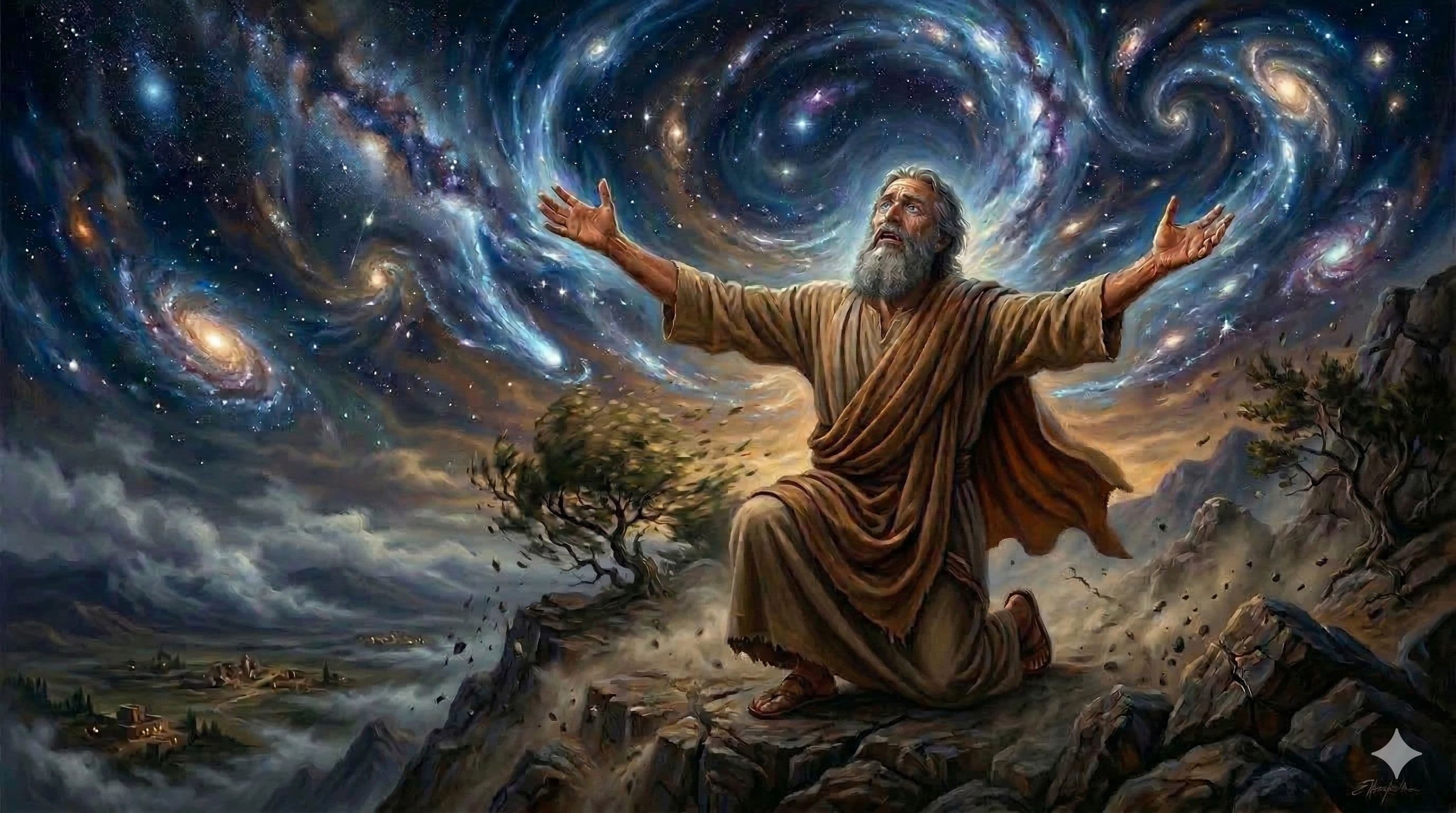
In the Book of Moses, Enoch’s weeping results in the shaking of the cosmos (Moses 7:41). While similar imagery can be found in biblical texts, the nuanced details surrounding Moses 7:41 provide a much stronger contextual match with extrabiblical sources, including those specifically related to Enoch.Many scriptural passages discuss the shaking of the heavens or the earth (or both) in the context of divine punishment or judgments.1 This imagery is also pervasive in Enoch texts and other pseudepigraphic documents.2 In contrast, relatively few passages discuss cosmic shaking specifically as a response to deep sorrow or grief, and even when such an association may be present, it is not always very apparent.3 This much rarer type of “cosmic shaking” imagery surfaces very clearly in Moses 7:38–41:
And that which I have chosen hath pled before my face. Wherefore, he suffereth for their sins; inasmuch as they will repent in the day that my Chosen shall return unto me, and until that day they shall be in torment; Wherefore, for this shall the heavens weep, yea, and all the workmanship of mine hands. And it came to pass that the Lord spake unto Enoch, and told Enoch all the doings of the children of men; wherefore Enoch knew, and looked upon their wickedness, and their misery, and wept and stretched forth his arms, and his heart swelled wide as eternity; and his bowels yearned; and all eternity shook.
Cosmic Shaking after Heavenly Weeping
This scene has close contextual parallels with several extrabiblical sources that feature cosmic shaking after God, the Messiah, or the hosts of heaven weep. One relevant passage comes from 3 Enoch 44:7, in which a heavenly initiate known as Rabbi Ishmael recounts the following vision:
I saw the souls of the fathers of the world, Abraham, Isaac, and Jacob, and the rest of the righteous, who had been raised from their graves and had ascended into heaven. They were praying before the Holy One, blessed be he, and saying in prayer, “Lord of the Universe, how long will you sit upon your throne, as a mourner sits in the days of his mourning, with your right hand behind you, and not redeem your sons and reveal your kingdom in the world? … Do you not pity your right hand behind you, by which you stretched out and spread the heavens, the earth, and the heaven of heavens? Have you no pity?”4
In this passage, the righteous patriarchs question God’s emotional response to sin and suffering, wondering why he doesn’t use his omnipotent power, symbolized by his right hand, to redeem Israel. Of particular interest is that they viewed God as mourning in the heavens. When the sins and judgments that would come upon Israel were communicated to these patriarchs, they at once “began to weep” themselves. It is then stated that “Michael, the Prince of Israel, cried out and lamented in a loud voice, saying, ‘Lord, why do you stand aside?’” (3 Enoch 44:10). We thus have God and the righteous heavenly hosts all weeping or mourning over human sin and suffering—a scene that is very reminiscent of the context that precedes cosmic shaking in Moses 7:38–41. A subsequent section of 3 Enoch then picks up on this same theme, declaring: “Then the right hand of the Omnipresent One wept, and five rivers of tears flowed from its five fingers, and, falling into the Great Sea, made the whole world quake” (3 Enoch 48A:4).5 Note that the weeping is induced by the withdrawal of God’s divine presence on the earth which leaves the world in wickedness, much like the withdrawal of Zion in Moses 7.6
Similar imagery can be found in the introduction to the Zohar, which describes the heavenly journey of a rabbi named Hiyya. At one point, a leading angel discloses information about what happens in the heavenly sanctuary, specifically how the heavenly king in his daily visits remembers his “doe” (a symbol of God’s divine presence or Shekinah) that was removed from the earth:
Meanwhile he noticed many of the Companions surrounding him—all those erect pillars—and he saw them being raised to the Academy of Heaven, some ascending, some descending. Above them all, he saw the Master of Wings approaching. When he arrived, he solemnly swore that he had heard from behind the curtain that the King remembers the doe who lies in the dust and visits Her every day. At that moment He kicks the 390 firmaments, which all tremble and quake before Him. He sheds tears over this, and those tears of bubbling fire fall into the vast ocean. From those tears the Prince of the Ocean emerges—by them he is sustained. And he hallows the name of the Holy King, agreeing to swallow up all the waters of Creation and absorb them when all the nations gather against the holy people, so that the waters will dry up and they will pass through on dry land. … Then Rabbi Shim’on told him the oath that the Master of Wings had sworn. The Messiah began trembling and cried aloud. The heavens trembled, the vast ocean trembled, Leviathan trembled, and the world verged on overturning.7
The Master of Wings appears to be Metatron (Enoch in his glorified state), which is the same angel who helped guide Rabbi Ishmael in 3 Enoch.8 Remarkably, both texts depict the loss of God’s divine presence and glory upon earth, followed by cosmic shaking and divine tears that fall into the sea. The mention of “tears of bubbling fire” in the Zohar passage echoes the “rivers of fire” mentioned several times throughout 3 Enoch, which are specifically described as falling “on the heads of the wicked in Gehinnom” in 3 Enoch 33:4–5.9 This is fascinating because similar fire/water imagery turns up in Moses 7:34: “And the fire of mine indignation is kindled against them; and in my hot displeasure will I send in the floods upon them, for my fierce anger is kindled against them” (Moses 7:34). In fact, this imagery is just seven verses away from the statement that “all eternity shook” (Moses 7:41). We thus get a complex of water/fire + cosmic shaking in the context of heavenly mourning and divine withdrawal in each text.10
Another important detail in the Zohar passage is that the Master of Wings disclosed information “from behind the curtain.” In Jewish tradition, Enoch-Metatron was intimately connected to the curtain in God’s celestial throne room,11 which in 3 Enoch 45:1 is said to be printed with “all the generations of the world and all their deeds, whether done or to be done.”12 This parallels the explanation in Moses 7:41 that “the Lord spake unto Enoch, and told Enoch all the doings of the children of men.” Crucial here is that, much like the Zohar passage above, curtain imagery turns up in close proximity to the cosmic shaking in Moses 7. In fact, as shown in the following chart, the divine curtain and shaking of eternity appear to be thematically related:13
Moses 7:30 | Moses 7:41 |
And were it possible that man could number the particles of the earth, yea, millions of earths like this, it would not be a beginning to the number of thy creations; and thy curtains are stretched out still; | And it came to pass that the Lord spake unto Enoch, and told Enoch all the doings of the children of men; wherefore Enoch knew, and looked upon their wickedness, and their misery, and wept and stretched forth his arms, and his heart swelled wide as eternity; and his bowels yearned; and all eternity shook. |
A separate Zohar text, known as Zohar Shemot, contains another relevant scene. It speaks of Eden as a secret location in the lower paradise of heaven where only the Messiah is allowed to enter. Within this realm, we learn about a particular location associated with God’s divine presence (or shekinah):
In that place the effigies are woven of all the nations who band together against Israel. The Messiah enters that abode, lifts up his eyes and beholds the Fathers (Patriarchs) visiting the ruins of God’s Sanctuary. He perceives mother Rachel, with tears upon her face; the Holy One, blessed be He, tries to comfort her, but she refuses to be comforted (Jer. 31, 14). Then the Messiah lifts up his voice and weeps, and the whole Garden of Eden quakes, and all the righteous and saints who are there break out in crying and lamentation with him. When the crying and weeping resound for the second time, the whole firmament above the Garden begins to shake, and the cry echoes from five hundred myriads of supernal hosts, until it reaches the highest Throne.14
Thus, once again, cosmic shaking is connected to a chorus of weeping and lamentation carried out by the Messiah and the hosts of heaven, all due to the loss of the divine presence upon earth. The statement that Rachel “refuses to be comforted” in this specific context is particularly interesting, as the same thing is mentioned of Enoch in Moses 7:44: “And as Enoch saw this, he had bitterness of soul, and wept over his brethren, and said unto the heavens: I will refuse to be comforted” (only 3 verses away from the cosmic shaking motif in Moses 7:41).15
Cosmic Shaking in Response to Prophetic Weeping
In the examples above, it was the weeping of heavenly beings (God, the Messiah, and other hosts of heaven) that caused the heavens and the earth to quake. In these scenes, the closest analog to Enoch’s weeping in Moses 7 comes from angelic beings like Michael, or the departed spirits of righteous saints and prophets, whose weeping mirrors that of God and the Messiah. However, there is an example of a living prophet whose sorrow and weeping caused the cosmos to tremble. This comes from a Jewish text called Devarim Rabbah, in which Moses learns that his time of death is nigh:
When Moses saw that his [death] sentence had been sealed, he decreed a fast upon himself, drew a small circle, stood within it, and said: “I am not moving from here until You void this decree.” At that moment, what did Moses do? He donned sackcloth, wrapped himself in sackcloth, covered himself with ashes, and stood in prayer and supplication before the Holy One blessed be He, until the heavens, the earth, and the order of Creation shook violently, and they said: “Perhaps, the desire of the Holy One blessed be He to renew His world has arrived.” A Divine Voice emerged and said: “The desire of the Holy One blessed be He to renew His world has not arrived.”16
While the text doesn’t explicitly say that Moses wept, he clearly entered into a state of mourning. His prayers to heaven, while in this condition, shook the cosmos much like the emotional state of Enoch in Moses 7:41.
One interesting detail in Devarim Rabbah is the refusal of Moses to leave the circle that he had made for himself. Essentially, he entered into a condition of mourning and self-imposed stasis—stubbornly refusing to eat or even move—until God changed his decree.17 This parallels Enoch’s declaration made in Moses 7:44: “I will refuse to be comforted.” Moreover, in both contexts the refusal to stop mourning was connected to unalterable divine pronouncement. Just as the fate of Moses was “sealed” by a divine “decree” in Devarim Rabbah, so too had Enoch learned that God had decreed that the wicked would die in the flood and be placed in spiritual prison.18 Thus, the shaking of the cosmos in each text is connected to a prophet’s refusal to be comforted after learning about an unalterable decree of death.19
Another fascinating correspondence in these accounts concerns anthropomorphic longing for a time of rest and renewal. In Devarim Rabbah, the heavens and the earth question if the time has yet arrived to renew the world (i.e., return it to a condition of peace and rest). The voice from heaven, however, declares that the time has not yet come. The confusion of the heavens and earth likely result from the fact that the cosmos are widely predicted (throughout scripture and in extrabiblical traditions) to shake at the time when the Messiah will come to reign on the earth.20 Whatever the cause, this sentiment echoes the anthropomorphic pleading of the earth in Moses 7:48: “And it came to pass that Enoch looked upon the earth; and he heard a voice from the bowels thereof, saying: … When shall I rest, and be cleansed from the filthiness which is gone forth out of me? When will my Creator sanctify me, that I may rest, and righteousness for a season abide upon my face?” This imagery shows up just seven verses away from the shaking of eternity in Moses 7:41.
Finally, it should be recognized that Devarim Rabbah features a chorus of heavenly voices that weep in response to the impending loss of Moses from the earth:
The Holy One blessed be He began weeping: “Who will rise up for me against the wicked? Who will take a stand for me against the evildoers?” (Psalms 94:16). And the Divine Presence says: “There has not arisen another prophet in Israel like Moses” (Deuteronomy 34:10). The heavens weep and say: “The pious one is lost from the land” (Micah 7:2). The earth weeps and says: “The upright among men is no more” (Micah 7:2). When Joshua sought his master but did not find him, he was weeping and saying: “Help, Lord, for the faithful man is no more, for trustworthiness has disappeared from among men” (Psalms 12:2). The ministering angels say: “He executed the righteousness of God” (Deuteronomy 33:21), and Israel said: “And His ordinances with Israel” (Deuteronomy 33:21). These and those were saying: “May he come in peace, may they rest on their resting places, one who walks in his uprightness” (Isaiah 57:2).
When combined with the mourning of Moses mentioned earlier, this neatly parallels the chorus of weeping in Moses 7, in which various parties—including God, the heavens, the earth, and the prophet himself—all weep over the edict of impending death, as well as for the loss of God’s presence upon the earth.21 It also doesn’t hurt that Moses and Enoch-Metatron are closely related figures in various extrabiblical traditions. There is reason to assume that their experiences with the divine might relate to one another.22
Conclusion
On its own, the mere fact that Moses 7:41 portrays the shaking of eternity is not particularly significant, as many passages in the Bible and Joseph Smith’s revelations evoke this type of imagery, typically in the context of divine judgment or punishment. Far fewer biblical texts depict cosmic shaking in response to mourning, as seen in the Book of Moses account. Yet, even then, no biblical passages feature the array of contextual parallels found between Moses 7 and the extrabiblical sources highlighted throughout this article.
The way that several of these sources portray scenes of cosmic shaking in the immediate context of a chorus of weeping is especially significant. In each text, the sorrow and lamentation carried out by God and the hosts of heaven are in response to the punishments that will come upon mankind, as well as the loss of the divine presence from the earth. Also of interest is that Enoch-Metatron plays a role in each of these accounts (except for Devarim Rabbah), either as an angel who reveals key details of the story, as a participant in the weeping, or as the source of cosmic shaking.
In addition, we get other unique or rare elements that turn up in close proximity to the shaking imagery in various texts. These include: (1) the questioning of God’s emotional response to human suffering, (2) Enoch-Metatron’s close association with the heavenly curtain, (3) the fiery water that falls from heaven, (4) anthropomorphic queries about a future day or rest or renewal, and (5) a stubborn refusal to be comforted. Also, in at least one other text, namely Devarim Rabbah, it is specifically the mourning of a prophet that causes the cosmic disturbance.
These contextual details, some of which arise simultaneously in multiple texts, seem too specific and unusual to arise by mere chance alone, especially when viewed collectively. At the same time, it is hard to imagine where Joseph Smith could have come across such accounts, as each of these Jewish sources were obscure and almost certainly inaccessible to him in English in 1830.23 Together, these findings strengthen the case for the antiquity and divine translation of the Book of Moses.
Jeffrey M. Bradshaw and David J. Larsen, In God’s Image and Likeness 2: Enoch, Noah, and the Tower of Babel (The Interpreter Foundation and Eborn Books, 2014), 151.
Hugh Nibley, Enoch the Prophet, The Collected Works of Hugh Nibley, Volume 2 (FARMS, 1986), 190.
Moses 7:34
Moses 7:38–41
Moses 7:44
Moses 7:48
- 1. Just a few representative examples of this imagery can be seen in 2 Samuel 22:8, Isaiah 13:13; Joel 3:16; Matthew 24:29; Hebrews 1226–27; Ether 4:9; D&C 84:118.
- 2. See Hugh Nibley, Enoch the Prophet, The Collected Works of Hugh Nibley, Volume 2 (FARMS, 1986), 14, 203–205.
- 3. See, for example, Jeremiah 4:23–28; Joel 2:10–12; Isaiah 24:4, 18–20.
- 4. Translation by Philip Alexander, “3 (Hebrew Apocalypse of) Enoch,” in The Old Testament Pseudepigrapha, 2 vols., ed. James H. Charlesworth (Doubleday, 1983–85), 1:295.
- 5. Alexander, “3 (Hebrew Apocalypse of) Enoch,” 301.
- 6. See Scripture Central, “Book of Moses Evidence: Themes of Weeping,” Evidence 525 (December 23, 2025).
- 7. Daniel C. Matt, trans., The Zohar, Pritzker edition, vol. 1 (Stanford University Press, 2004), 22–24. See also Zohar Introduction 10:55–59, online at sefaria.org. For a biblical precedent of the doe (or gazelle) imagery used in the context of mourning, see the heading to Psalm 22.
- 8. Concerning the association of Metatron with this chief angel, see Matt, The Zohar, 22n.150.
- 9. Alexander, “3 (Hebrew Apocalypse of) Enoch,” 287.
- 10. For related references, see Nibley, Enoch the Prophet, 199–200.
- 11. According to Andrei A. Orlov, The Enoch-Metatron Tradition, Texts and Studies in Ancient Judaism 107 (Mohr Siebeck, 2005), 115–116: “Metatron’s service behind the heavenly Curtain, Pargod, recalls the unique function of the earthly high priest, who alone was allowed to enter behind the veil of the terrestrial sanctuary.”
- 12. Alexander, “3 (Hebrew Apocalypse of) Enoch,” 296.
- 13. For more on these textual relationships, see Scripture Central, “Book of Moses Evidence: Stretched Curtain Imagery,” Evidence 536 (March 11, 2026).
- 14. Zohar Shemot 13:109–110, online at sefaria.org. Cited in Nibley, Enoch the Prophet, 190.
- 15. For more on the significance of Jeremiah’s writings in connection to the weeping motif in Moses 7, see Scripture Central, “Book of Moses Evidence: Themes of Weeping,” Evidence 525 (December 23, 2025). It may be that the imagery of Rachel refusing to be comforted actually derives from earlier Enochic traditions.
- 16. Devarim Rabbah 11:10, online at sefaria.org.
- 17. A similar tradition comes from the Mishnah, which describes a Jew living in the first century BC named Honi. See “Honi The Circle Maker,” online at sefaria.org.
- 18. This relationship arises as one compares Moses 7:38–39 with Moses 6:29–30: “a hell I have prepared for them, if they repent not; And this is a decree, which I have sent forth in the beginning of the world, from my own mouth, from the foundation thereof, and by the mouths of my servants, thy fathers, have I decreed it, even as it shall be sent forth in the world, unto the ends thereof.” These passages seem to parallel one another in content and context.
- 19. Interestingly, there is also a divine decree preserving life in Moses 7:52: “And he sent forth an unalterable decree, that a remnant of his seed should always be found among all nations, while the earth should stand.”
- 20. See, for example, Moses 7:61: “And the day shall come that the earth shall rest, but before that day the heavens shall be darkened, and a veil of darkness shall cover the earth; and the heavens shall shake, and also the earth; and great tribulations shall be among the children of men, but my people will I preserve.”
- 21. See Scripture Central, “Book of Moses Evidence: Themes of Weeping,” Evidence 525 (December 23, 2025).
- 22. See Orlov, The Enoch-Metatron Tradition, 254–303. See also Scripture Central, “Book of Moses Evidence: Enoch Stood Before God’s Face,” Evidence 519 (November 5, 2025).
- 23. For a discussion of the limitations of accessing the Zohar and other kabbalistic sources in Joseph Smith’s environment, see Allen Hansen, “Joseph Smith and the Kabbalah: A New Look at the Evidence,” 2024 FAIR Conference, online at fairlatterdaysaints.org.