Evidence #564 | November 5, 2026
Book of Moses Evidence: Book of Remembrance
Post contributed by
Scripture Central
Abstract
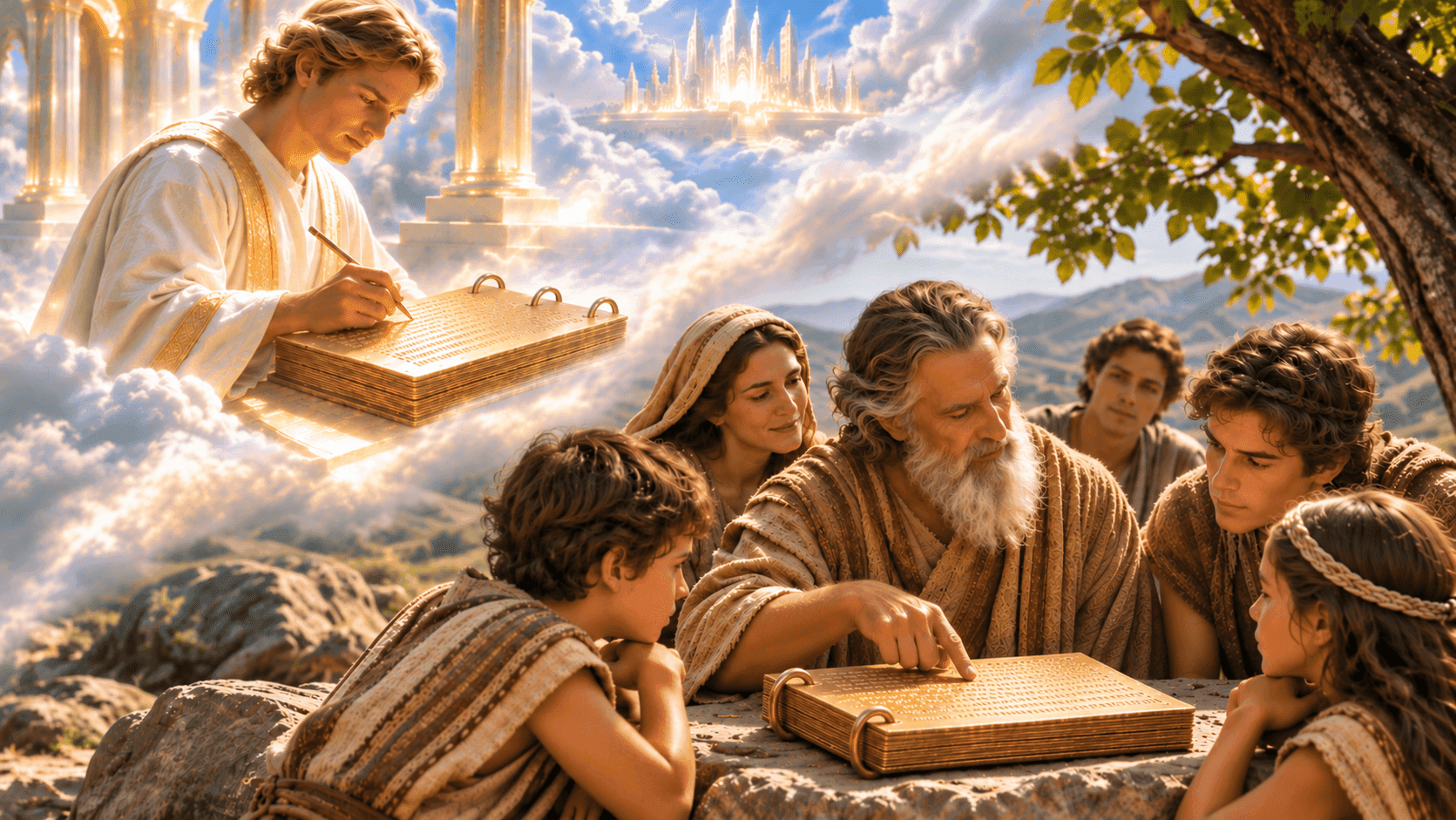
Moses 6 twice mentions an obscure record known as the “book of remembrance.” The distinctive details surrounding these references form a network of compelling parallels with several Jewish traditions.One of the most intriguing aspects of Moses 6—and, indeed, of the entire Book of Moses—is the twice-repeated reference to an obscure record called the “book of remembrance.” The first instance arises in a discussion of recordkeeping among the antediluvian patriarchs: “And a book of remembrance was kept, in the which was recorded, in the language of Adam, for it was given unto as many as called upon God to write by the spirit of inspiration” (Moses 6:5). The second reference is made by the prophet Enoch as he was preaching to the people: “For a book of remembrance we have written among us, according to the pattern given by the finger of God” (Moses 6:46).
A separate evidence article covers many other aspects of books and writing in Moses 6.1 Although clearly relevant to that broader discussion, the “book of remembrance” is being treated separately here due to its unusual length and complexity. Together, these articles make an exceptionally strong case that these textual details are part of a genuinely ancient tradition that was most likely inaccessible to Joseph Smith in 1830.
Broader Scriptural Usage
A general association between written media and memory can be found in many scriptural passages. One well-known example is Exodus 17:14: “And the Lord said unto Moses, Write this for a memorial in a book, and rehearse it in the ears of Joshua: for I will utterly put out the remembrance of Amalek from under heaven.” In the New Testament, Peter wrote two epistles to “stir up your pure minds by way of remembrance” (2 Peter 3:1). Concerning the sacred records preserved among the Nephites, Alma explained that “they have enlarged the memory of this people” (Alma 37:8). Additional passages could be cited.2
In contrast, specific references to a “book of remembrance” are remarkably rare. In the entire King James Bible, the only mention of such a book arises in Malachi 3:16: “Then they that feared the Lord spake often one to another: and the Lord hearkened, and heard it, and a book of remembrance was written before him for them that feared the Lord, and that thought upon his name.” As understood by George Nickelsburg, this appears to be a heavenly register of the “names, and perhaps deeds” of the righteous and “will serve as a memorandum on the day of judgment.”3
References to a “book of remembrance” are also rare in Joseph Smith’s own revelations. Outside of Moses 6, it is independently used just one other time in Restoration scripture, specifically in D&C 85:9: “And all they who are not found written in the book of remembrance shall find none inheritance in that day.” Another instance arises in 3 Nephi 24:16, but that passage is merely quoting from Malachi 3:16.
Moses 6 as an Expansion of Genesis 4–5
The specific context in which the “book of remembrance” arises in Moses 6 is crucial for understanding several parallels highlighted throughout this article. In particular, it should be understood that Moses 6:2–8 functions as an expansion of the final two verses of Genesis 4 and the opening verse of Genesis 5.
The following chart shows how these separate works relate to one another. Especially important is the fact that the “book of remembrance” arises in close proximity to a discussion of the “book of the generations of Adam” found in Moses 6:8 (quoting Genesis 5:1). This suggests the two records were either synonymous or closely related in some way that the Genesis account itself never hints at.4 They have thus been color-coded for additional emphasis. All parallel text has been bolded.5
Genesis 4–5 | Moses 6 |
4:25 And Adam knew his wife again; and she bare a son, and called his name Seth: For God, said she, hath appointed me another seed instead of Abel, whom Cain slew. | 2 And Adam knew his wife again, and she bare a son, and he called his name Seth. And Adam glorified the name of God; for he said: God hath appointed me another seed, instead of Abel, whom Cain slew. |
4:26 And to Seth, to him also there was born a son; and he called his name Enos: then began men to call upon the name of the Lord. | 3 And God revealed himself unto Seth, and he rebelled not, but offered an acceptable sacrifice, like unto his brother Abel. And to him also was born a son, and he called his name Enos. 4 And then began these men to call upon the name of the Lord, and the Lord blessed them; |
5:1 This is the book of the generations of Adam. In the day that God created man, in the likeness of God made he him; | 5 And a book of remembrance was kept, in the which was recorded, in the language of Adam, for it was given unto as many as called upon God to write by the spirit of inspiration; 6 And by them their children were taught to read and write, having a language which was pure and undefiled. 7 Now this same Priesthood, which was in the beginning, shall be in the end of the world also. 8 Now this prophecy Adam spake, as he was moved upon by the Holy Ghost, and a genealogy was kept of the children of God. And this was the book of the generations of Adam, saying: In the day that God created man, in the likeness of God made he him; |
Parallels with the Zohar Yitro
With these relationships in mind, it is fascinating that a “book of remembrance” is likewise mentioned in a commentary on Genesis 5:1 found in a Jewish work known as Zohar Yitro:
We were further taught concerning the mystery contained in the words “this is the book” [Genesis 5:1] that there are two books, an upper and a lower book. The lower book is the “book of remembrance”, and the upper one is called “this”. And in order to show that the two are not separated, but form one, it is written “this is the book”. There are two grades, male and female.
For all the souls and spirits that enter human beings are alluded to in the words “generations of man (Adam)”, for they all issue from the “Righteous One”, and this is the “watering of the river that went out of Eden to water the garden” (Gen. 2, 10).
There is also another, a lower “Adam”, alluded to in the words, “on the day that God created man (Adam)”, in the same verse. In regard to the upper Adam, the union of male and female is at first only distantly alluded to in the words “this is the book”, but after they produced offspring they are called openly “Adam”. Then it is said that God made man in the “likeness” of God. By the word “likeness” we are to understand a kind of mirror in which images appear momentarily and then pass away.6
This source declares that Genesis 5:1 contains a “mystery,” suggesting a deeper meaning is concealed beneath the ordinary sense of the verse. Central to that mystery is a series of corresponding realities: an upper and lower book, an upper and lower Adam, and male and female categories that are distinct yet united. Although the “book of remembrance” belongs to the lower order, it corresponds in some way to an unidentified upper book, the two being described as inseparable and ultimately forming one. The lower Adam likewise corresponds to an upper Adam. These concepts are then associated with the principle of mankind being made in the “likeness” of God.7
The commentary also gives an expansive meaning to the “generations of Adam.” Rather than referring only to the genealogical descendants immediately listed in Genesis 5, the phrase encompasses “all the souls and spirits that enter human beings.” Related Jewish traditions develop a very similar idea in this same context.8
In light of this summary, the first—and most astonishing—consistency with Moses 6 is the simple fact that both texts refer to a “book of remembrance” in immediate connection to the “book of the generations of Adam” in Genesis 5:1.
A second parallel comes from Adam’s priesthood-related prophecy recorded in Moses 6:4–7:
And then began these men to call upon the name of the Lord, and the Lord blessed them; And a book of remembrance was kept, in the which was recorded, in the language of Adam, for it was given unto as many as called upon God to write by the spirit of inspiration; And by them their children were taught to read and write, having a language which was pure and undefiled. Now this same Priesthood, which was in the beginning, shall be in the end of the world also. Now this prophecy Adam spake, as he was moved upon by the Holy Ghost.9
The sweeping scope of this prediction becomes more apparent when read alongside other Restoration texts. In Moses 5:10 Adam prophesied concerning “all the families of the earth,” and in D&C 107:56 he “predicted whatsoever should befall his posterity unto the latest generation.” Using these passages as an interpretive backdrop, as well as a host of Jewish sources that seem to invoke a similar idea in this setting, it seems most likely that Adam’s priesthood-related prophecy in Moses 6:7 either derives from or closely relates to his comprehensive foreknowledge of his future posterity.10 This meaningfully resembles the connection between the “book of remembrance” and “all the souls and spirits that enter human beings” in Zohar Yitro.
Another important correspondence involves the relationship between earthly and heavenly realities. Genesis 5:1–2 itself invokes the idea of “likeness,” but only in the notion that humanity was created in the likeness of God. Moses 6 contains this same imagery, but it also applies it specifically in relation to the “book of remembrance” itself, which is said to have been written “according to the pattern given by the finger of God” (Moses 6:46).11 This suggests the earthly book of remembrance may have been modeled after a heavenly book of a similar nature.
This interpretation becomes even more inviting when one considers the language found later in the same chapter in connection to the ordinance of baptism and the Plan of Salvation:
Therefore it is given to abide in you; the record of heaven; the Comforter; … And behold, all things have their likeness, and all things are created and made to bear record of me, both things which are temporal, and things which are spiritual; things which are in the heavens above, and things which are on the earth, and things which are in the earth, and things which are under the earth, both above and beneath: all things bear record of me. (Moses 6:61–63)
In this framework, that which is “temporal” is paired with things which are “spiritual,” just as the “heavens above” correspond to “the earth … beneath.” Furthermore, things above and below jointly “bear record” of God in connection to the principle that “all things have their likeness.”12 A theme of recordkeeping is thus closely intertwined with God’s upper and lower creations, as well as the principle of their corresponding “likeness.” The fundamental message seems to be that the Plan of Salvation is embedded with upper-lower dualities that in some way jointly testify of God’s creative designs and purposes for his children, almost in the same manner that multiple corroborating witnesses in a court of law are mutually strengthening.13
Other modern revelations shed further light on these themes. D&C 132:7 describes the seal of the “Holy Spirit of promise” as necessary for any “covenants, contracts, bonds, obligations, oaths, vows, performances, connections, associations, or expectations” to possess “efficacy, virtue, or force in and after the resurrection from the dead.” This helps explain why God’s Spirit is described as the “record of heaven” in Moses 6:61.14 It serves as the divine ratifying witness by which earthly acts, such as priesthood ordinances, are recorded and bound in heaven, for “by the Spirit ye are justified” (Moses 6:60). This backdrop may also help illuminate, to some extent, what it means to “write by the spirit of inspiration” in connection to the “book of remembrance,” as paired together in Moses 6:5.
The principle of heavenly and earthly correspondence is developed even more explicitly in D&C 128:9:
It may seem to some to be a very bold doctrine that we talk of—a power which records or binds on earth and binds in heaven. Nevertheless, in all ages of the world, whenever the Lord has given a dispensation of the priesthood to any man by actual revelation, or any set of men, this power has always been given. Hence, whatsoever those men did in authority, in the name of the Lord, and did it truly and faithfully, and kept a proper and faithful record of the same, it became a law on earth and in heaven, and could not be annulled, according to the decrees of the great Jehovah.
This discussion is particularly relevant because it concerns baptism, the very ordinance associated with the “record of heaven” in Moses 6:60–63. Tellingly, D&C 128 invokes the principle of likeness in this very same context: “the baptismal font was instituted as a similitude of the grave, and was commanded to be in a place underneath where the living are wont to assemble, to show forth the living and the dead, and that all things may have their likeness, and that they may accord one with another—that which is earthly conforming to that which is heavenly” (D&C 128:13).
The Book of Moses and other Restoration texts thus present a consistent theme of earthly ordinances and records that correspond to heavenly counterparts. This theological complex resonates with the imagery in Zohar Yitro, which pairs together a “lower” book (the book of remembrance) with an unidentified “upper” book. In fact, it could be argued that these Restoration doctrines provide a valuable contextual backdrop that may help illuminate the deeper “mystery” alluded to in the Zohar.
On yet another level, this inherent upper-lower correspondence may help explain, in the first place, why the “book of remembrance” shows up specifically in connection to the discussion of Adam being in the “likeness” of God (Moses 6:5–8). Put simply, just as man was fashioned after the “likeness” of God’s image, so too do sacred records on earth have a similitude or likeness with records in heaven.
The connection may go even deeper than that, though, because there is a similar duality in the creation of mankind itself. In Moses 6:51, God tells Adam, “I made the world, and men before they were in the flesh.” Moses 3:5–7 develops the idea more fully, describing humanity as existing spiritually before appearing naturally upon the earth. Adam was thus “the first flesh upon the earth” even though “all things were before created; but spiritually were they created.” As the pre-mortal Jesus told the brother of Jared, “Seest thou that ye are created after mine own image? Yea, even all men were created in the beginning after mine own image. Behold, this body, which ye now behold, is the body of my spirit; and man have I created after the body of my spirit; and even as I appear unto thee to be in the spirit will I appear unto my people in the flesh” (Ether 3:15–16).15 In other words, Christ’s spirit body and his physical body held a clear resemblance to one another, which suggests the same is likely true for all of God’s children who enter mortality.
These details can help shape our understanding of Moses 6:44: “The heavens he made; the earth is his footstool; and the foundation thereof is his. Behold, he laid it, an host of men hath he brought in upon the face thereof.” Not only does this passage turn up in very close proximity to the discussion of the “book of remembrance” in Moses 6:46, but it seems to suggest the same type of duality just described. According to Aaron Schade and Matthew Bowen, “The mention that ‘an host of men hath he brought in upon’ the earth appears to reference a spiritual existence before mortality (Moses 6:44; compare 3:5, 7; 6:51). If so, Enoch understood the reality of a spiritual existence before a physical one.”16 This last piece of the puzzle may help account for, or at least relate to, the imagery in Zohar Yitro of an “upper” Adam that is paired with a “lower” Adam, as it plausibly reflects the dual creation of his spiritual and physical identities.17
Taken together, the parallels between Zohar Yitro and the Book of Moses are quite impressive. Both traditions (1) refer to a “book of remembrance” in connection with the “book of the generations of Adam” in Genesis 5:1, (2) present the book of remembrance as a lower counterpart to a heavenly book or pattern of writing, (3) associate this upper-and-lower relationship with the principle of similarity or likeness, (4) portray Adam as having a corresponding upper (spiritual) and lower (physical) identities, and (5) appear to connect these records with a comprehensive awareness of Adam’s future posterity. These converging parallels create a remarkably specific interpretive profile surrounding Genesis 5:1 that is difficult to attribute either to chance or to shared biblical imagery alone.
Parallels with Zohar Vayakhel
Another fascinating set of resemblances comes from the explanation of one Rabbi Simeon recorded in Zohar Vayakhel:
He next discoursed on the verse: “Then they that fear the Lord spoke one with another; and the Lord hearkened, and heard, and a book of remembrance was written before him, for them that fear the Lord, and that thought upon his name” (Malachi 3, 16). This verse, he said, presents a difficulty in using the word nidb’ru (lit. they were spoken) instead of dibbru (they spoke). What it signifies, however, is the repetition of the words spoken on earth in the upper world, by all the sacred hosts and legions.
For the words of the holy Law spoken here below ascend on high, where multitudes come to meet them to take them up and present them before the Holy King, there to be adorned with many crowns woven of the supernal radiances. All these words, then, are self-spoken, as it were, before the Most High King. Whoever saw such joy, whoever witnessed such praises, as mount up into all those heavens at the moment those words ascend, whilst the Holy King looks on them and crowns Himself with them! They spring up and down, they settle, as it were, on His bosom for Him to disport Himself with them, whence they ascend toward His head and are woven there into a crown. Hence the words spoken by the Torah: “and I would be playing always before him” (Prov. 8, 30).
In the verse cited there is twice mention of “them that fear the Lord”; the first indicates the men themselves as they are here below, and the second their images as reflected in their words that ascend on high. This esoteric doctrine is found in the Book of Enoch, where it says that all the words of exposition uttered by the righteous on earth are adorned with crowns and are arrayed before the Holy One, blessed be He, who delights Himself with them. They then descend and come up again before His presence in the image of that righteous man who gave expression to them, and God then delights Himself with that image. The words, then, are inscribed in “a book of remembrance before Him,” so as to endure for evermore.18
As can be seen, the upper-lower dichotomy is again quite pronounced. Words spoken “on earth” are repeated by heavenly hosts in the “upper world.” It should be recalled that just before the “book of remembrance” is mentioned in the Book of Moses, it is reported that men began “to call upon the name of the Lord” (Moses 6:4–5). The imagery of words ascending into heaven is therefore immediately relevant to the book of remembrance in each text.
There is also an element of heavenly mediation involved, as the words of the righteous in Zohar Vayakhel are conveyed into the upper world by angelic beings. This at least loosely corresponds to the role of heavenly messengers in Restoration scripture, where angels may “speak by the power of the Holy Ghost” and participate in the transmission of divine words between heaven and earth (2 Nephi 32:3).19 In Moses 6, the words in the book of remembrance are specifically facilitated by the “spirit of inspiration” (Moses 6:5).
The concept of “likeness” is also present. In the case of Zohar Vayakhel, however, words themselves are viewed as an “image” or reflection of those who spoke them. Thus, when the words are transported to the heavens, a righteous man below has a corresponding “image” above, as reflected in his words. This resonates, at least thematically, with the “likeness” imagery in Moses 6 and Zohar Yitro, in which things below are in the pattern or likeness of things above, both in regard to the book of remembrance and also concerning Adam or mankind.
Interestingly, both Zohar Vayakhel and Malachi 3:16 place the “book of remembrance” in a heavenly setting. More specifically, Zohar Vayakhel explains that the words of the righteous on earth are carried into heaven and “inscribed in ‘a book of remembrance before Him’, so as to endure for evermore.” At first glance, this seems to stand in tension with Moses 6 and Zohar Yitro, which instead depict the book of remembrance as an earthly record. The difference, however, may be more apparent than real. This comes from the possibility that the book of remembrance may conceptually belong to the broader Near Eastern pattern of “doubled documents,” in which corresponding records preserve the same (or very similar) contents.20 If so, each text could reasonably be given the same label, and their conflation would be somewhat expected.
This concept is particularly at home within Enochic literature. Hugh Nibley once explained,
The idea of doubled sets of books, one on earth and one in heaven, is also widespread and very ancient. Of Enoch’s writings we are told, ‘some of them are written and inscribed above in the heaven, in order that the angels may read them’ (1 Enoch 108:7), while Enoch’s own writings are transcripts from a book kept in heaven, and made known in sundry portions to the Fathers, all of whom, but most notably Enoch, report having got their information by ‘reading it in the heavenly tablets’ (for example, Jubilees 4:1). Thus by the books above and below, brought together like the sticks of Joseph and Ephraim in perfect agreement as perfectly agreeing witnesses, the world will be judged.21
This leads to one of the more intriguing and uniquely significant features of Zohar Vayakhel. Unlike Zohar Yitro, it explicitly states that its “esoteric doctrine” of upper and lower correspondence “is found in the Book of Enoch.” That should ring a bell because it is precisely within the Enoch-focused account in the Book of Moses that we encounter both a reference to the “book of remembrance” and also the upper-lower symbolism of earthly and heavenly correspondence. According to Andrei Orlov,
The important aspect of the early portrayals of Enoch as a scribe is that they depict him in the capacity of both celestial and terrestrial scribe, as the one who not only records messages from his heavenly guides, but also composes petitions at the request of the creatures from the lower realms, for example, the fallen Watchers/Giants who ask him for mediation. The celestial and terrestrial sides of Enoch’s duties as a scribe reveal the composite nature of this important role.22
This opens up yet another layer of resemblance that might easily be overlooked. One of the distinctive features of Zohar Vayakhel is its association of the words of the righteous with heavenly crowns. It reports that, according to the book of Enoch, “all the words of exposition uttered by the righteous on earth are adorned with crowns and are arrayed before the Holy One.” Elsewhere in the same passage, these words ascend toward God’s head and are specifically “woven there into a crown.” The imagery therefore places heavenly inscription and coronation in close association with the book of remembrance.
Among the major extant Enochic texts, the most likely candidate for this allusion comes from 3 Enoch 13–14, in which crowns are likewise associated with heavenly writing. What makes this passage especially noteworthy is that its crown imagery occurs within a broader cluster of motifs that closely resembles material in Moses 6, as illustrated in the following chart:
Moses 6 | 3 Enoch 13–14 |
44 The heavens he made; the earth is his footstool; and the foundation thereof is his. Behold, he laid it, an host of men hath he brought in upon the face thereof. 46 For a book of remembrance we have written among us, according to the pattern given by the finger of God; and it is given in our own language. 47 And as Enoch spake forth the words of God, the people trembled, and could not stand in his presence. 63 And behold, all things have their likeness, and all things are created and made to bear record of me, both things which are temporal, and things which are spiritual; things which are in the heavens above, and things which are on the earth, and things which are in the earth, and things which are under the earth, both above and beneath: all things bear record of me. | 13:1 Out of the abundant love and great compassion wherewith the Holy One, blessed be he, loved and cherished me more than all the denizens of the heights, he wrote with his finger, as with a pen of flame, upon the crown which was on my head, the letters by which heaven and earth were created; 14:1 When the Holy One, blessed be he, placed this crown upon my head, all the princes of kingdoms who are in the height of the heaven of ʿArabot and all the legions of every heaven trembled at me. … 14:5 They all fell prostrate when they saw me and could not look at me because of the majesty, splendor, beauty, brightness, brilliance, and radiance of the glorious crown which was on my head. |
The convergence here is quite surprising. Much like the book of remembrance was “written … according to the pattern given by the finger of God,” we read in 3 Enoch that God “wrote with his finger, as with a pen of flame, upon the crown which was on my head.” The crown and the book of remembrance can therefore be viewed as parallel mediums of divinely inscribed text, each of which invoked fear and trembling in others, to the point where they could not stand. A final resemblance involves shared creation themes. While these parallels would be suggestive on their own, Zohar Vayakhel supplies a crucial conceptual link by explicitly bringing the Enochic crown imagery into the same interpretive space as the “book of remembrance.”23
Parallels with 4QInstruction
Many scholars have recognized that the Zohar very likely preserves and repackages strains of much earlier Jewish traditions.24 It is thus entirely plausible that the treatments of the book of remembrance in Zohar Yitro and Zohar Vayakhel could reflect genuinely ancient material. Such speculation, however, would greatly benefit from some type of earlier corroboration outside of the Book of Moses. This is where a Dead Sea Scrolls text commonly known as 4QInstruction becomes quite significant, as it presents a discussion of the book of remembrance that fits several of the same themes and motifs that have already been discussed, as well as introducing new exclusive parallels with Moses 6.25
4QInstruction can be characterized as a somewhat fragmentary wisdom text concerned with teaching a pupil the hidden structure of reality, the nature of divine judgment, and humanity’s place within an ordered and foreknown cosmos. A full English translation of the most relevant fragment of the text (4Q417 1 I) is provided below so that each of its relevant features can be assessed in context. This translation derives from a significant monograph on 4QInstruction by Matthew Goff, and his editorial markings (brackets, superscripted text, etc.) have been retained for the sake of accuracy. To facilitate better readability, however, all subsequent analysis will cleanly present the text as plausibly reconstructed.
- [ … and] you, under[stan]ding one …
- … and … [and] the wond[ro]us mysteries [of the God of awesome deeds you shall understand. The origin of …]
- … your … and gaze [upon the mystery that is to be and the deeds of] old, at what exists and what
- [has existed, upon what will be] … [for]ever to … [at what exists]
- [and at what has existed, upon what will be] … all … deed upon d[eed]
- [ … day and night meditate upon the mystery that] is to be and study (it) constantly. And then you will know truth and iniquity, wisdom
- [and folly]. You … [their] deed[s] in all their ways together with their punishment in all the everlasting ages and the punishment
- of eternity. And then you will know the difference between [go]od and [evil according to their] deeds, [f]or the God of Knowledge is a foundation of truth. With the mystery that is to be
- he spread out its foundation and indeed m[ade (it) with wis]dom and, regarding everything, [with cleve]rness he fashioned it. The dominion of its deeds
- for a[l]l … and all [wi]th a[l]l … He [has l]aid out for their un[de]rstanding every d[ee]d so that one may walk
- in [the inclination of] his intelligence, and he spread out for A[dam] … for … and with precision of intelligence were made kn[own the sec]rets
- of his plan, together with his walking [for (he is) pe]rfe[ct in all] his [d]eeds. These things seek constantly and understand [al]l
- their consequences. And then you will know the glory of [his] st[rength together] with his wondrous mysteries and the mighty acts of his deeds. And you,
- understanding one, inherit your reward in remembrance of the per[iod for] it comes. Engraved is the statute and ordained is all the punishment
- because engraved is that which is ordained by God against all the in[iq]uit[ie]s of the sons of Sheth. And the book of remembrance is written before him
- for the ones who keep his word—that is, the vision of meditation of the book of remembrance. He bequeathed it to Adam (אנוש) together with a spiritual people be[cau]se
- according to the likeness of the holy ones he fashioned him. But no more did he give what is meditated upon to the fleshly spirit, for it did not distinguish between
- [go]od and evil according to the judgment of its [sp]irit. vacat And you, understanding son, gaze vacat upon the mystery that is to be and know
- [the path]s of all life and the manner of one’s walking that is appointed over [his] deed[s] … and iniqui[ty] …
- [under]stand the difference between great and small. In your counsel …
- … your … in the mystery that is to be …
- … every vision know. And in all …
- B[e s]trong constantly. Do not be touched by iniquity [ … for all who touch]
- it will not be considered innocent. According to his inheritance in it he will be co[nsidered wicked … And you,]
- intelligent son, understand your mysteries and the [eternal] foundation[s know …]
- founded by you are a[ll] their [dee]ds, together with the reward of …
- Never follow afte[r] you[r] heart and after your e[y]es [after which you lust …]
Since scholars have debated the correct translation of several key passages in this text, caution should be had before reaching any definitive interpretations. That being said, it is fascinating that, in several instances, an intriguing parallel with the Book of Moses arises no matter which alternative interpretation has been put forward. Because the analysis of this text is more complex and lengthy than usual, each topic will be given its own subsection below.
A Reference to the Book of Remembrance
The most significant point of comparison with the Book of Moses is the unambiguous reference to the “book of remembrance” itself in line 15, which is repeated again in line 16. As explained by Goff, it “can be reasonably compared to the ‘tablets of heaven’ prominent in 1 Enoch and Jubilees, as well as the ‘tablets of destiny’ of Mesopotamian tradition.” Goff further points out that the “book of remembrance” is derived from Malachi 3:16, which reasonably portrays it as a “‘divine ledger’ in which the words and the deeds of the pious are recorded.”26
The Bestower and Recipient of the Book of Remembrance
Identifying the bestower and recipient of the book of remembrance in 4QInstruction has been a matter of ongoing debate among scholars. Concerning the relevant passages in this regard (lines 16–17), John Collins writes that they have “been translated in a surprising variety of ways.”27 Conveniently, in his treatment of this topic, Collins reproduces several translations for comparison:
Wacholder and Abegg translate: “And he (Seth?) bequeathed it to Enosh with the people of the spirit. Because he created it as a sacred blueprint (tabnit). But Haguy had not as yet been entrusted to the spirit of flesh since it (spirit of flesh) had as yet not known the distinction between good and evil.” Torleif Elgvin renders the passage: “He gave it as an inheritance to man with a spiritual people, for He fashioned it as a model for the holy ones. He had not yet given the Hagi to the spirit of flesh, for he could not discern between [goo]d and evil with the judgment of his [sp]irit.” Daniel Harrington translates as follows: “And He gave it as an inheritance to Humankind (or, Enosh) together with a spiritual people. For according to the pattern of the Holy Ones is his fashioning. But no more has meditation been given to fleshly spirit, for it knew not the difference between good and evil according to the judgment of its spirit.” Finally Armin Lange: “Und er hat es Enosch gemeinsam mit dem Volk des Geistes zum Erbteil gegeben, [den]n gemäß der Gestalt der Heiligen ist seine [Ge]sinnung. Doch die Erklärung wurde nicht dem Geist des Fleisches gegeben, denn er vermag nicht, zwischen Gut und Böse zu unterscheiden gemäss dem Gesetz seines Geistes.”28
When translated into English, Lange’s German reads: “And he gave it to Enosh, together with the people of the spirit, as an inheritance, for his disposition is according to the pattern of the holy ones. But the explanation was not given to the spirit of flesh, for it is unable to distinguish between good and evil according to the law of its spirit.”29 Collins himself takes the position that it is God who gives the book to Adam.30 Likewise, Goff’s translation reads: “He bequeathed it to Adam (אנוש) together with a spiritual people because according to the likeness of the holy ones he fashioned him” (lines 16–17).
Other interpretations could be consulted, but, in general, the bestower of the book of remembrance has been assumed to be God himself. It is not impossible, however, that the verb could point slightly further back to Seth, as suggested in the translation by Wacholder and Abegg. One factor complicating this reading is that the name of Seth isn’t given in its usual form. While not decisive on its own, this leaves some room for doubt.31 Another concern is that Seth is generally viewed as a righteous antediluvian patriarch in early Jewish sources. In contrast, several translations of line 15 associate Seth with a wicked group of his posterity.32 For example, Goff’s translation reads: “engraved is that which is ordained by God against all the iniquities of the sons of Sheth.” This has led some scholars to suspect that this is actually not a reference to Seth (the son of Adam) but is instead an allusion to the wicked “children of Sheth” mentioned in Numbers 24:17, a group far removed from the antediluvian patriarchs.33
Determining the true identity of this figure is fairly significant because it affects how one may understand the recipient of the book. If Adam’s son, Seth, was indeed mentioned in the previous line, it strengthens the possibility that Seth’s son, Enos (also spelled Enosh), might be the figure designated by אנוש (ʾĕnôš), who was the recipient of the book.34 This line of interpretation seems to have been taken (or viewed as optional) by several translators, including Wacholder and Abegg, Harrington, and Lange.
Collins, however, specifically critiques Lange’s view on this matter: “Even if we assume that the word is read correctly as Seth, Lange has to suppose that a unique understanding of the tradition underlies the present passage, whereby the onset of iniquity begins in the generation of Enosh, but Enosh and the spiritual people constitute a righteous remnant. He [Lange] cites no parallels for this interpretation, and I have been unable to find any.” Collins further argues, “The notion that a book is given to Enosh is also, to my knowledge, without parallel.”35
Remarkably, the Book of Moses adequately fills in the missing gaps that Lange’s interpretation implicitly rests upon. It is rather striking, for instance, that the “book of remembrance” is referenced in immediate connection to both Seth and Enos in Moses 6:3–6. Moreover, the text implies that this book was “kept” by the righteous patriarchs of Adam’s posterity, providing a natural scenario in which Enos might specifically inherit the book of remembrance:
And God revealed himself unto Seth, and he rebelled not, but offered an acceptable sacrifice, like unto his brother Abel. And to him also was born a son, and he called his name Enos. And then began these men to call upon the name of the Lord, and the Lord blessed them; And a book of remembrance was kept, in the which was recorded, in the language of Adam, for it was given unto as many as called upon God to write by the spirit of inspiration; And by them their children were taught to read and write, having a language which was pure and undefiled.
But what about the wickedness of the children of Seth? Is there any evidence for that missing piece of the puzzle? Later in Moses 6, when the genealogy of Seth and Enos is given, a curious digression about growing wickedness among their posterity follows:
And Seth lived, after he begat Enos, eight hundred and seven years, and begat many sons and daughters. And the children of men were numerous upon all the face of the land. And in those days Satan had great dominion among men, and raged in their hearts; and from thenceforth came wars and bloodshed; and a man’s hand was against his own brother, in administering death, because of secret works, seeking for power. All the days of Seth were nine hundred and twelve years, and he died. (Moses 6:14–16)36
In the very next verse, it is reported that “Enos and the residue of the people of God came out from the land, which was called Shulon, and dwelt in a land of promise” (Moses 6:17). This aptly corresponds to the idea that “Enosh and the spiritual people constitute a righteous remnant,” in a period of growing wickedness, as described by Collins. The Book of Moses therefore presents the very types of details that Collins predicted would be needed for Lange’s interpretation to be valid.
On the other hand, a fairly recent article by Meike Christian reevaluates the key passage in lines 14–15 of 4QInstruction that involves the name of Seth. Because the text is fragmentary and because some of the terms are ambiguous, it is quite possible to reach an entirely new reading. In her reconstruction, Christian argues that the text may be best understood to say:
Engraved is the {your} statute and inscribed is the whole task. For engraved is that which is determined by God about the whole ser[vic]e of the sons of Seth, and a book of remembrance is written before him for those who keep his word.37
As reconstructed, the term translated as “service” (עבודת) would suggest that Seth’s children had fulfilled some type of important office or accomplished a set of tasks or duties in connection to the book of remembrance.38 This dramatically changes the meaning of the passage, in the sense that the sons of Seth can now be viewed in a positive, rather than negative, light. The interpretation is inviting because it results in a natural flow of ideas, where the righteous “sons of Seth” are viewed as identical with the “spiritual people” who inherit the book of remembrance.39
In many other biblical passages, the Hebrew term עבודת (ʿavodah), which is crucial to Christian’s reconstruction, specifically involves priestly service.40 Thus, if Christian’s proposal is correct, it resonates quite well with Moses 6:5–7, where the “book of remembrance” is immediately connected to the holy order of the “priesthood” that was apparently perpetuated by Seth and his righteous posterity.
The crucial point is that the Book of Moses can ably account for either reading. If the children of Seth are viewed negatively, Moses 6:15–17 supplies precisely the type of details that would make sense of that interpretation, as outlined by Collins. Conversely, if the children of Seth are viewed positively, as argued by Christian, the Book of Moses can certainly make sense of that as well, since Seth and his posterity are positively described in Moses 6:3–4 and are connected to a “priesthood” order in Moses 6:7.41 Since both lines of textual evidence arise in fairly close proximity to the “book of remembrance” mentioned in Moses 6:5, either interpretation could be reasonably accommodated.
As for the recipient of the book of remembrance, if one assumes that Seth, the son of Adam, is most likely the figure mentioned in line 15, that would amplify the plausibility of אנוש being a reference to Seth’s son, Enos, in line 16. As discussed previously, this reading would make perfect sense in light of Moses 6:3–5, where both Seth and Enos are mentioned in close connection with the “book of remembrance” being “kept” among Adam’s righteous posterity.
However, the presence of Seth’s name would not automatically favor Enos as the figure being referenced by אנוש in line 16. Collins instead favors reading אנוש as Adam, which he supports by pointing to an analogous usage in another Dead Sea Scrolls text.42 Further evidence comes from the use of the phrase “likeness of the holy ones” in line 17, which conceptually correlates to Adam being formed in the “likeness” of God’s “image” in the Genesis account.43 There is also a reference to the knowledge of “good and evil” in line 18, which correlates to Adam’s knowledge of good and evil in Genesis 2–3. Goff follows Collins’ line of reasoning on these matters, arguing further that “the construal of Adam as a recipient of heavenly knowledge is consistent with his depiction elsewhere in early Jewish literature.”44 Neither Goff nor Collins seems to have been aware that Adam is specifically connected to the “book of remembrance” in Zohar Yitro, as discussed previously. This final line of evidence strengthens their already persuasive analysis on this matter.
In contrast, Collins finds the notion that אנוש generically refers to “man” or “mankind” as being problematic: “אנוש is associated with ‘a spiritual people’ but is not identified with them and is also distinguished from ‘the spirit of flesh.’ The word, then, cannot be taken to refer simply to humanity in general.”45 Goff agrees: “Given that the ‘spiritual people’ are reasonably understood as a category of people … it is not clear why line 16 would state that the vision is given to them and to humanity in general.”46
With this analysis in place, it seems most likely that Adam is indeed intended as the recipient of the “book of remembrance” in 4QInstruction. This, once again, is remarkably in line with the Book of Moses: “And a book of remembrance was kept … in the language of Adam” (Moses 6:5). Adam is closely paired with this record again in Moses 6:45–46: “even the first of all we know, even Adam. For a book of remembrance we have written among us.” On the other hand, if one prefers to view the book as being bestowed upon Enos—which seems to be the next most likely reading—Moses 6:3–7 can just as easily account for that as well. Either interpretation presents a meaningful parallel.
A Spiritual People
According to 4QInstruction, the book of remembrance is associated with something termed the “vision of meditation” as well as a “spiritual people.” By way of review, lines 15–16 read: “And the book of remembrance is written before him for the ones who keep his word—that is, the vision of meditation of the book of remembrance. He bequeathed it to Adam (אנוש) together with a spiritual people.”
Goff explains, “The identification of the book of remembrance as the vision of meditation … can be understood as answering an exegetical question—if the book of remembrance is in heaven and available for the elect on earth, how do they get access to it? Line 16 explains that it is (והואה) a ‘vision of meditation’ of ‘the book of remembrance.’ They receive on earth a vision of a book in heaven.”47 Goff further points out that the term vision (חזון) “denotes divine revelation.”48 Thus, in his view, it is the revelatory vision of the book of remembrance that is given to Adam and the spiritual people.
Collins reads the text more ambiguously: “We are told that God gave the Book, or Vision, of Hagu to אנוש.”49 In a subsequent description, Collins uses “book” in this context without the qualification: “In 4Q417 the book is given to Adam together with a spiritual people, or ‘people of spirit.’ This people, in turn, is contrasted with ‘the spirit of flesh.’ Lange thinks that the spiritual people are angels. It is not apparent, however, why an angelic host should need such a book.”50
Whether it is the book of remembrance itself or a vision of the book that was given to Adam, there can be no question that the book had a heavenly origin or counterpart and that it (or a vision of it) was given to a people who were, in some manner, spiritually enlightened. This nicely corresponds to the heavenly provenance of the book of remembrance in Moses 6:46: “For a book of remembrance we have written among us, according to the pattern given by the finger of God.” It also aligns with the reference to the “spirit of inspiration” in Moses 6:5: “And a book of remembrance was kept … for it was given unto as many as called upon God to write by the spirit of inspiration.” Naturally, it requires a spiritual people to write by the spirit of inspiration.
A Likeness, Pattern, or Blueprint
We now turn our attention to the language of “likeness” in lines 16–17: “He bequeathed it to Adam (אנוש) together with a spiritual people because according to the likeness of the holy ones he fashioned him.” Concerning this term, Collins notes that it “is used in the Hebrew Bible with the sense of a blueprint for a construction, notably the blueprint for the Tabernacle in Exodus 25:9, 40. It is also used in the sense of a figure or image.”51 Building on Collins’ view that it was Adam who was fashioned after the likeness of the holy ones (i.e., angels), Goff assumes it is both Adam and the spiritual people who were created according to this “likeness” principle.52
It must be acknowledged, though, that specifically who or what is being fashioned in the “likeness” of the holy ones isn’t precisely clear in the underlying Hebrew. It can only be inferred. Understanding the referent to be Adam or a spiritual people certainly makes sense, and there is precedent for this conclusion in the Genesis account. But that reading isn’t mandated by the text. A genuinely viable alternative is that it is actually the “book of remembrance” itself that was fashioned in relation to the “likeness” of something.
This interpretation seems to be reflected in the translation from Torleif Elgvin: “He gave it as an inheritance to man with a spiritual people, for He fashioned it as a model for the holy ones.” Wacholder and Abegg also lean in this direction, but with their own variation: “And he (Seth?) bequeathed it to Enosh with the people of the spirit. Because he created it as a sacred blueprint (tabnit).”53 Under these interpretations, the book of remembrance would seem to conform to (or possibly provide) some type of heavenly blueprint or pattern. Harrington, in fact, specifically uses the phrase “according to the pattern of the Holy Ones” in his translation.54
This all becomes quite fascinating when one recalls the specific language from Moses 6:46: “For a book of remembrance we have written among us, according to the pattern given by the finger of God.” In effect, the book of remembrance was given after the pattern of holy or heavenly writing, which presumably would be used not only by God himself but also by his heavenly messengers (i.e., the holy ones).55
It might also be recalled that the “book of remembrance” in Moses 6:5 is closely followed by a description of Adam and mankind being made “in the likeness of God” and in “the image of his own body” (Moses 6:8–9). This aligns with the interpretation preferred by Collins, Goff, and Harrington. Thus, once again, competing interpretations of 4QInstruction hold a meaningful parallel to Moses 6, no matter which approach one finds more persuasive.
Spiritual People vs. A Fleshy Spirit
In lines 16–18 of 4QInstruction, the “spiritual people” associated with אנוש and the book of remembrance are contrasted with a “fleshy spirit” that doesn’t comprehend the difference between good and evil: “He bequeathed it to Adam (אנוש) together with a spiritual people because according to the likeness of the holy ones he fashioned him. But no more did he give what is meditated upon to the fleshly spirit, for it did not distinguish between good and evil according to the judgment of its spirit.” The initiate is further warned to “not be touched by iniquity” (line 23), and also to “never follow after your heart and after your eyes after which you lust” (line 27).
As previously noted, the idea that a “spiritual people” had privileged access to the sacred knowledge of the book of remembrance finds a parallel in the “spirit of inspiration” mentioned in Moses 6:5. It also resonates with the “language which was pure and undefiled” in Moses 6:6. On several occasions, the Book of Moses contrasts this righteous community with incursions of growing wickedness. As the Lord mentioned in Moses 6:27, “their hearts have waxed hard, and their ears are dull of hearing, and their eyes cannot see afar off.” The loss of their physical senses seems to be a metaphor for their loss of spiritual enlightenment or discernment.56
Not long after these descriptions of spiritual degeneration, Enoch was told to anoint his eyes with clay, after which he “beheld also things which were not visible to the natural eye.” Specifically, Enoch “beheld the spirits that God had created” (Moses 6:36). In the next chapter, we are told that Enoch witnessed the “world for the space of many generations” (Moses 7:4) as well as “all the inhabitants of the earth” (Moses 7:21). In other words, Enoch received something akin to the comprehensive knowledge envisioned in 4QInstruction, which appears to have been exemplified by a primordial revelation to Adam (line 11). This is rather intriguing because some Jewish sources affirm that Adam and Enoch indeed had similar revelatory experiences.57
In summary, Moses 6 pointedly contrasts the dull spiritual senses of the wicked with the heightened spiritual senses of the righteous, a distinction that parallels the “spiritual people” and “fleshy spirit” of 4QInstruction. In both texts, spiritual receptivity determines one’s ability to perceive divine realities that remain hidden from others.
Dual Creation Motif
On another level, Collins links the spiritual and fleshy dichotomy in 4QInstruction to Philo’s view of the dual creation of mankind:
It is well-known that Philo of Alexandria understood Genesis to refer to a double creation of Man, and that he derived this understanding from an exegetical tradition. In expounding Genesis 2:7 (the Lord God formed man from the dust of the earth) Philo says: “There are two types of men; the one a heavenly man, the other an earthly. The heavenly man, being made after the image of God, is altogether without part or lot in corruptible and terrestrial substance; but the earthly one was compacted out of the matter scattered here and there, which Moses calls clay.” Philo understands the two Adams in his own philosophical framework, which is far removed from the thought world of Qumran. What Philo and Qumran have in common, however, is the biblical text, and possibly some elements of a tradition of interpretation. 58
Collins also connects what he calls the “duality of human existence” to a variant tradition described in another Dead Sea Scrolls text known as Instruction on the Two Spirits. “At the very least,” he concludes, “it is clear that the interpretation of Genesis, and the forces determining human behavior, were subjects of lively debate in Judean wisdom circles in the second century B.C.E. and in the circles responsible for the Dead Sea Scrolls.”59 In other words, there was a range of such traditions and 4QInstruction seems to be interacting with them on some level.
The significance here is that these upper and lower aspects of Adam and the creation of mankind resonate with previous discussions of this theme in the two Zohar texts and the Book of Moses. Although 4QInstruction does not explicitly develop these themes, scholars have independently intuited the connection. This strengthens the thesis that these texts may all reflect a shared ancient tradition.
God’s Divine Plan
A significant feature of 4QInstruction is its presentation of God’s divine plan. When broken down into its constituent parts, the plan features at least the following elements:
- a divine mystery or secret
- a clear emphasis on God’s foreknowledge of all things
- references to past, present, and future realities
- an emphasis on “deeds,” apparently in reference to both God and mankind
- the idea that God has “laid out” or “spread out” this mystery to initiates
- use of the words “made,” “fashioned,” and “foundation,” signaling God’s creative activities
- the need for an initiate to gain “knowledge,” both of God’s plan and of “good and evil”
- the repeated use of “all” or “every” to indicate the comprehensiveness of the mystery
In summary, it appears that the “secrets of [God’s] plan” or the “mystery that is to be” involves God’s comprehensive foreknowledge of all the good and evil deeds and activities of mankind, as well as God’s own creative and intervening actions. As assessed by Goff, the divine plan involves “the deterministic schema established by God according to which reality unfolds.”60 Benjamin Wold agrees but holds a nuanced interpretation of the deterministic nature of the plan:
This mystery may relate to the consequences of human action in future, but it is unconvincing that this mystery is about a person’s predetermined eternal fate. Indeed, in the opening column of 4QInstruction (4Q416 1), the structure of the cosmos serves to justify future judgment on those who do not live according to the knowledge of good and evil, as evident around them, and sets the context for teaching about the need to live wisely.61
Wold further explains,
In 4Q417 1 i, the mystery is also explicitly associated with the three points of time: past, present, and future. … As such, the mystery of existence is concerned with relating humanity to their position in the cosmos and instructing them how to conduct themselves accordingly. By presenting the plan of the world from creation to judgment, human beings are able to understand good and evil and the consequences for failing to live accordingly.62
In Latter-day Saint parlance, one could reasonably conclude that God presented to Adam (or possibly to mankind) something akin to the Plan of Salvation. While the version of this divine plan in 4QInstruction is undoubtedly incomplete and perhaps somewhat contaminated (at least when contrasted with its full development in Restoration theology), several essential concepts seem to be largely intact.63
The mere presence of this divine plan in 4QInstruction is quite significant. This is because Moses 6 holds what can be viewed as the first recorded reference to, and explication of, the Plan of Salvation in the Latter-day Saint scriptural canon.64 Although there may be different ways of dividing up the narrative, the textual unit in which the Plan of Salvation is developed arguably spans Moses 6:43–63. The “book of remembrance” is mentioned near the beginning of this unit, specifically in verse 46. The two concepts therefore seem to be thematically related, just as they are in 4QInstruction.65
Another line of evidence supporting this connection comes from a rendition of primordial history found in the Book of Mormon. As the following chart demonstrates, the same cluster of elements leading up to and surrounding the “plan of salvation” in Alma 12:28–30 also arises in connection to the “book of remembrance” in Moses 5:57–6:5:
Moses 5–6 | Alma 12 |
5:57 For they would not hearken unto his voice, nor believe on his Only Begotten Son, even him whom he declared should come in the meridian of time, who was prepared from before the foundation of the world. 5:58 And thus the Gospel began to be preached, from the beginning, being declared by holy angels sent forth from the presence of God, and by his own voice, and by the gift of the Holy Ghost. … 6:4 And then began these men to call upon the name of the Lord, and the Lord blessed them; 6:5 And a book of remembrance was kept, in the which was recorded, in the language of Adam, for it was given unto as many as called upon God to write by the spirit of inspiration; | 28 And after God had appointed that these things should come unto man, behold, then he saw that it was expedient that man should know concerning the things whereof he had appointed unto them; 29 Therefore he sent angels to converse with them, who caused men to behold of his glory. 30 And they began from that time forth to call on his name; therefore God conversed with men, and made known unto them the plan of redemption, which had been prepared from the foundation of the world; and this he made known unto them according to their faith and repentance and their holy works. |
Hence, there is reason to believe that the book of remembrance described in Moses 6:5 is conceptually linked to the plan of salvation, as framed within Joseph Smith’s broader theological framework. More specifically, some scholars have proposed that the ancient authors of the Book of Mormon likely drew much of their doctrine and teachings—including their knowledge of the Plan of Salvation—from a text much like the Book of Moses.66 If so, that would help explain the strong convergence of elements among these particular passages. In fact, among all chapters within the Book of Mormon that appear to have multiple interactions with the Book of Moses, Alma 12–13 arguably have the highest sustained concentration of parallels.67 So there is a persuasive reason to assume that this relationship is not mere happenstance.
Finally, it should be pointed out that several ancient and medieval sources depict Adam or Enoch as having unique knowledge pertaining to God’s creations and the comprehensive scope of his plans for humanity.68 In some cases, this knowledge was believed to hold a mysterious or secret nature, much like the divine plan in 4QInstruction. One Islamic source, for instance, mentions that a record known as the Book of Secrets was passed down to Enoch by his father.69
The Plan Is Laid Out from the Foundation of the World
As the plan develops throughout Moses 6, a number of other similarities with 4QInstruction also arise. In Moses 6:44—just two verses before the “book of remembrance” is mentioned in Moses 6:46—we read, “The heavens he made; the earth is his footstool; and the foundation thereof is his. Behold, he laid it, an host of men hath he brought in upon the face thereof.”70 Similar imagery comes from Moses 5:57–59, which states that God’s Only Begotten Son “was prepared from before the foundation of the world.” In connection to Christ’s atonement, it is later reported that children are “whole from the foundation of the world” (Moses 6:54). In other words, a plan of redemption that rested on the sacrifice of God’s Only Begotten Son was prepared from the beginning, even for small children.
This language, describing the “foundation” of the world and it being “laid” out, corresponds most closely to the imagery developed in lines 8–11 of 4QInstruction: “for the God of Knowledge is a foundation of truth. With the mystery that is to be he spread out its foundation and indeed made it with wisdom and … he fashioned it. … He has laid out for their understanding every deed so that one may walk in the inclination of his intelligence, and he spread out for Adam.”71 In lines 25–26, the initiate is instructed to understand God’s mysteries and “the eternal foundations know … founded by you are all their deeds.”
Summarizing lines 8–9, Goff writes, “These lines proclaim that God created the world by means of the mystery that is to be.” Goff points to the term “foundation” as “denoting that God fashioned the world.”72 He further notes that “what is being laid out is not clear, but context suggests that knowledge of the created order and God’s dominion over it are disclosed to this figure.”73 Elsewhere, Goff clarifies that “the root פרש can mean both ‘spread out’ (פרשׂ) and ‘expound/explain’ (פרשׁ). 4QInstruction draws upon both meanings of the root. God spread out the foundations of the world and made them intelligible for the addressee.”74 So we are clearly dealing with creation imagery and the disclosure of divine knowledge in both texts.
Related language repeatedly crops up in connection to the plan of salvation in the Book of Mormon. By some measures, these instances are even more on point than the passages in Moses 6, since they specifically associate the plan with “knowledge” that is “expounded” or “laid” out in connection to the “foundation” of the world. They also regularly invoke the term “prepare,” which strongly points to God’s foreknowledge—the very essence of the “mystery that is to be” in 4QInstruction.
- “will ye reject all the words which have been spoken concerning Christ … and make a mock of the great plan of redemption, which hath been laid for you?” (Jacob 6:8)
- “Now, if it had not been for the plan of redemption, which was laid from the foundation of the world, there could have been no resurrection of the dead; but there was a plan of redemption laid, which shall bring to pass the resurrection of the dead, of which has been spoken.” (Alma 12:25)
- “therefore God conversed with men, and made known unto them the plan of redemption, which had been prepared from the foundation of the world” (Alma 12:30)
- “But God did call on men, in the name of his Son, (this being the plan of redemption which was laid).” (Alma 12:33)
- “Therefore, this was the cause for which the sons of Mosiah had undertaken the work, that … perhaps they might bring them to know of the plan of redemption.” (Alma 17:16)
- “But this is not all; for he expounded [i.e., spread out or laid out] unto them the plan of redemption, which was prepared from the foundation of the world” (Alma 18:39)
- “And Aaron did expound [i.e., spread out or lay out] unto him the scriptures from the creation of Adam, laying the fall of man before him, and their carnal state and also the plan of redemption, which was prepared from the foundation of the world” (Alma 22:13)
- “therefore, in his mercy he doth visit us by his angels, that the plan of salvation might be made known unto us” (Alma 24:14)
- “if ye will repent and harden not your hearts, immediately shall the great plan of redemption be brought about unto you. For behold, this life is the time for men to prepare to meet God” (Alma 34:31–32)
- “Is it not as necessary that the plan of redemption should be made known unto this people as well as unto their children?” (Alma 39:18)
Knowing Good and Evil
In connection with God’s divine plan, 4QInstruction further states that those who diligently meditate and study upon the mystery that is to be will come to “know the difference between good and evil” (line 8). Goff explains,
Since the “fleshly spirit” does not have the knowledge of good and evil (l. 17), one can infer that the “spiritual people” do. It can be deduced further that this knowledge is inscribed in the heavenly book of remembrance. This suggests that the knowledge of good and evil does not merely denote the ability to choose right from wrong but also signifies broad insights into the nature of reality and God’s deterministic plan that shapes it, which is inscribed in this book (see above on ll. 15–16).75
In other words, the “good and evil” dichotomy is simultaneously wrapped up in the divine plan imagery as well as the book of remembrance. Moses 6:56, in fairly close proximity to the mention of the plan of salvation, likewise states concerning mankind that it is “given unto them to know good and evil.”76 Moreover, as mankind grows up from childhood, “they taste the bitter, that they may know to prize the good” (Moses 6:55).77 Even more on point, as described in Moses 5:10–11, Adam and Eve’s knowledge of “good and evil, and the joy of our redemption” is closely connected to Adam’s prophetic foreknowledge concerning “all the families of the earth.” Both texts therefore connect the knowledge of good and evil with a comprehensive understanding of God’s plan, as it unfolds in the deeds of Adam’s posterity throughout the ages.
Divine Counsel
When describing the growing wickedness of the people, God explained to Enoch that mankind “have sought their own counsels in the dark; and in their own abominations have they devised murder, and have not kept the commandments” (Moses 6:28). Later, Enoch himself declared, “ye are my brethren, and why counsel ye yourselves, and deny the God of heaven?” (Moses 6:43). In the next chapter, the Lord declared, “Man of Counsel is my name” (Moses 7:35). And in Moses 5:25 it is reported that Cain “rejected the greater counsel which was had from God” (Moses 5:25). Clearly, this element holds thematic significance.
Unfortunately, the relevant portion of 4QInstruction is damaged, making it difficult to establish a precise relationship. As plausibly reconstructed, lines 18–22 read, “And you, understanding son, gaze … upon the mystery that is to be and know the paths of all life and the manner of one’s walking that is appointed over his deeds … and iniquity … understand the difference between great and small. In your counsel … … your … in the mystery that is to be … … every vision know.”78
Although some of the text is missing, the presence of “great and small” just before the use of the term “counsel” is clearly discernible. This may be significant because Moses 5:25 specifically speaks of “greater counsel” coming from God, suggesting that the people were rejecting God’s comparatively greater wisdom in favor of the lesser cunning of Satan or mankind.79 Goff sees the elements of “great and small” in 4QInstruction as participating in other binary imagery related to the divine plan, including “truth and iniquity, wisdom and folly, and good and evil.”80
All-Inclusive Language
4QInstruction repeatedly uses all-inclusive language in connection to the mystery that is to be. According to lines 9–10, “The dominion of its deeds for all … and all with all … He has laid out for their understanding every deed.” Likewise, lines 12–13 state that God is “perfect in all his deeds” and that the initiate should “seek constantly and understand all their consequences.” Line 7 speaks of “all their ways” and “all the everlasting ages.” Such descriptions emphasize the all-encompassing and superlative nature of God’s divine plan. One notices similar repetition in connection to the Plan of Salvation in Moses 6:61–63:
Therefore it is given to abide in you; the record of heaven; the Comforter; the peaceable things of immortal glory; the truth of all things; that which quickeneth all things, which maketh alive all things; that which knoweth all things, and hath all power according to wisdom, mercy, truth, justice, and judgment. And now, behold, I say unto you: This is the plan of salvation unto all men, through the blood of mine Only Begotten, who shall come in the meridian of time. And behold, all things have their likeness … all things bear record of me.
Once again, meaningful parallels also arise in the Book of Mormon, where witnessing a comprehensive revelation is frequently described as obtaining a knowledge of “all things.” For instance, at the conclusion of his panoramic vision of human history, Nephi explained, “And also others who have been, to them hath [God] shown all things, and they have written them; and they are sealed up to come forth in their purity” (1 Nephi 14:26). As in this instance, such knowledge is regularly said to be contained in sacred or sealed records, mirroring the apparent function of the book of remembrance in 4QInstruction.
In his second book, Nephi prophesied that the sealed portion of the Book of Mormon would also contain this mystery: “the revelation which was sealed shall be kept in the book until the own due time of the Lord, that [the words of the book] may come forth; for behold, they reveal all things from the foundation of the world unto the end thereof. … and all things shall be revealed unto the children of men which ever have been among the children of men, and which ever will be even unto the end of the earth” (2 Nephi 27:10–11).
Likewise, according to Ether 3:25–26, the Lord “showed unto the brother of Jared all the inhabitants of the earth which had been, and also all that would be; and he withheld them not from his sight, even unto the ends of the earth. For he had said unto him in times before, that if he would believe in him that he could show unto him all things—it should be shown unto him; therefore the Lord could not withhold anything from him, for he knew that the Lord could show him all things.” Many similar passages could be cited.81 One might also notice that many of these descriptions explicitly discuss this plan in relation to both the past and the future, from the beginning to the end, a theme that is discussed in greater detail in the next section.
Past, Present, and Future
The divine plan in 4QInstruction is considered to be a “mystery” that encompasses past, present, and future realities. Lines 3–4 tell the initiate to “gaze upon the mystery that is to be and the deeds of old, at what exists and what has existed, upon what will be … forever to … at what exists and at what has existed, upon what will be.” Although the text is fairly damaged at this point, Goff argues that the “theme of learning about the entire breadth of history is conveyed in lines 3–4 by a tripartite division of time. … In each instance the niphal participle denotes specifically either the past, present or future as part of a longer formula that signifies the entirety of time.”82 In addition to providing literary and grammatical justification for his proposal, Goff also relies on comparisons with other texts, such as Revelation, to support his reconstruction.83
One partial correlation with this imagery can be seen in Adam’s prediction that “this same Priesthood, which was in the beginning, shall be in the end of the world also” (Moses 6:7). Similarly, in Moses 5:56–59, Christ being “prepared from before the foundation of the world” is contrasted with Christ’s gospel being preached “in the world, until the end thereof.” In these cases, two of the three temporal categories (past and future) show up in fairly close connection to the book of remembrance (Moses 6:5).
Although the full tripartite understanding of God’s plan is not clearly present in Moses 6, it sometimes turns up in connection to the Plan of Salvation and divine mysteries in the Book of Mormon. For instance, concerning God’s nature, Nephi taught, “I, Nephi, was desirous also that I might see, and hear, and know of these things, by the power of the Holy Ghost, which is the gift of God unto all those who diligently seek him, as well in times of old as in the time that he should manifest himself unto the children of men. For he is the same yesterday, today, and forever; and the way is prepared for all men from the foundation of the world, if it so be that they repent and come unto him. For he that diligently seeketh shall find; and the mysteries of God shall be unfolded unto them, by the power of the Holy Ghost, as well in these times as in times of old, and as well in times of old as in times to come; wherefore, the course of the Lord is one eternal round” (1 Nephi 10:18–19).84
Conclusion
This analysis has revealed an intriguing network of correspondences between the Book of Moses and several Jewish sources. The most important factor is the shared use of the distinctive phrase “book of remembrance.” As has already been pointed out, this book is scripturally rare. Outside of Moses 6, it is mentioned just once in the Bible (Malachi 3:16) and only one other time in Smith’s other revelations (D&C 85:9). Thus, on a fundamental level, we are dealing with a precisely similar and fairly unusual concept.
The next consideration involves the distinctive contexts in which the “book of remembrance” appears in the Book of Moses. Perhaps most significant is its placement in Moses 6:5. This verse is part of an expansion of the biblical narrative situated between Genesis 4:26 (quoted in Moses 6:4) and Genesis 5:1 (quoted in Moses 6:8). This means that the “book of remembrance” holds a clear and unambiguous relationship to the “book of the generations of Adam” mentioned in Genesis 5:1. As a matter of raw statistical probability, the likelihood of Joseph Smith randomly placing a reference to the “book of remembrance” in such close proximity to his singular quotation of Genesis 5:1 is quite low (less than 1 in 550).85 It is therefore remarkable that Zohar Yitro brings up the “book of remembrance” in its commentary on this very same biblical passage.
It could be assumed that the “book of the generations of Adam” in Genesis 5:1 might have reminded Joseph Smith of the “book of remembrance” in Malachi 3:16, since both involve a registry of names. While that possibility must be considered, nothing else in the Bible would suggest any sort of equivalence or close relationship between the two works. Both books are mentioned just a single time and, textually speaking, are about as far apart from one another as possible within the Hebrew Bible. They also belong to fundamentally different domains of reality. As presented in Genesis 5:1, the book of the generations of Adam appears to be a fairly ordinary, earthbound genealogical registry. The book of remembrance, on the other hand, is presented in Malachi 3:16 as a heavenly record of those who fear God, preserving their names and deeds in anticipation of divine judgment and reward. Thus, while it is not impossible that one text could have prompted Smith to invoke the other, that explanatory hypothesis shouldn’t be assumed to be particularly likely.
One way to better assess its plausibility is to explore whether other Western scholars leading up to 1830 ever made this same connection. In other words, if the two texts, as presented in the Bible, hold a genuinely obvious and meaningful relationship, then one might expect a number of biblical scholars and religious thinkers, in addition to Joseph Smith, to notice and draw attention to it.
Yet that doesn’t appear to be the case. After conducting several generalized searches involving hundreds of biblical commentaries and reference works (with the help of multiple AI platforms), and after a much more thorough review of twenty particularly influential authors and their works (assessed directly by Scripture Central staff), no positive evidence surfaced in this regard.86 Apparently, the mere fact that the book of the generations of Adam (Genesis 5:1) and the book of remembrance (Malachi 3:16) both involve a registry of names wasn’t enough for Western religious commentators to assume any specific relationship between them. While these search efforts could have missed a positive example, the evidence currently suggests that any perceived connection between Genesis 5:1 and Malachi 3:16 is either absent or exceedingly rare in biblical scholarship leading up to 1830.
The next most important contextual parallel involves the relationship between the book of remembrance and the prophet Enoch. Based on the genealogical context of Doctrine and Covenants 107:57, it seems quite plausible that the discussion of Adam’s genealogy in Moses 6 was anciently part of Enoch’s writings. The fact that most of Moses 6–7 focuses its narrative on the prophet Enoch adds further credibility to that idea. This means that the reference to the “book of remembrance” in Moses 6:5 can plausibly be attributed to Enoch’s writings, although that possibility cannot be proven. More importantly, Enoch himself specifically mentions the “book of remembrance” in Moses 6:46. So there can be no question that the Book of Moses associates Enoch with this obscure text.
That being the case, it is remarkable that Zohar Vayakhel specifically connects the book of remembrance, mentioned in Malachi 3:16, with an “esoteric doctrine … found in the Book of Enoch.” Nothing in the Bible itself suggests that Enoch wrote any books or records. Nor does it state that Enoch was preoccupied with antediluvian books or writings. And it certainly doesn’t connect Enoch specifically to the book of remembrance. Even if Smith were aware of extrabiblical sources that associate Enoch, generally speaking, with books or scribal practices, that still would not provide a good reason to assume his writings elaborated particularly on the book of remembrance.87 Once again, robust AI-enhanced searches indicate that other Western scholars and religious thinkers were not independently connecting this particular book with Enoch before 1830.88
Because the antiquity of the traditions in these two Zohar texts is uncertain, it would be helpful if a much older source could, at least to some degree, help corroborate their claims. This is where 4QInstruction becomes particularly significant. While it doesn’t independently confirm that the book of remembrance was associated with Genesis 5:1 or the writings of Enoch, it does strongly suggest that these Zohar texts are interacting with a genuinely ancient tradition.
On a variety of levels, 4QInstruction holds parallels with one Zohar work or the other, and, in some cases, both simultaneously. In each instance, a meaningful connection with the Book of Moses is also clearly present or can be reasonably inferred. At the same time, 4QInstruction features a series of independent relationships with Moses 6 and related Restoration scripture, most of which involve various facets of God’s divine plan. The following chart can help the reader more easily track this complex array of intertextual relationships.
Topic | Yitro | Vayakhel | 4QI | Moses |
Explicit reference to a “book of remembrance” is given | X | X | X | X |
Book of remembrance is associated with a secret or mystery | X | X | X | / |
Language of “likeness” or “pattern” is used in connection to Adam or the book of remembrance (or both) | X | X | X | X |
Earthly records or writings have a heavenly counterpart | X | X | X | X |
Sacred records or knowledge are transmitted between heaven and earth | X | / | X | |
Book of remembrance is associated with Enoch and his writings | X | X | ||
Comprehensive knowledge of human generations is mentioned | X | X | X | |
Book of remembrance is associated with Adam or his descendants | X | / | X | |
Heavenly and earthly aspects of Adam or humanity are contrasted | X | / | X | |
Book of remembrance is associated with Adam’s genealogy | X | / | X | |
Book of remembrance is explicitly linked to Genesis 5:1 | X | X | ||
Book of remembrance is associated with a people possessing spiritual gifts or perception | X | X | ||
Explicit reference to a divine plan is given | X | X | ||
Divine plan is associated with creation imagery (heavens, earth, foundation, etc.) | X | X | ||
Divine plan features past, present, and future temporalities | X | / | ||
Divine plan emphasizes God’s foreknowledge | X | X | ||
Divine plan is unfolded or laid out | X | / | ||
Divine plan includes knowledge of good and evil | X | X | ||
Divine plan is associated with “counsel” imagery | X | X | ||
Divine plan is associated with all-inclusive language | X | X | ||
X = Clearly Present / = Reasonably Inferred | ||||
In two crucial instances—the relationship with Genesis 5:1 and also with the writings of Enoch—it seems quite unlikely that the details in Moses 6 would mirror these extrabiblical sources. But the true force of the argument only becomes apparent in the aggregate. Why is it that so many elements in Moses 6 interact with multiple Jewish sources on so many different levels, while those sources also exhibit substantial overlap with one another on several of the very same points—all in connection with the book of remembrance? The convergence is as striking as it is unexpected.
It must also be recognized that none of these particular sources would have reasonably been available to Joseph Smith in 1830. The Dead Sea Scrolls, including 4QInstruction, remained undiscovered until the mid-twentieth century. Although the Zohar had circulated in printed editions since the sixteenth century, its predominantly Aramaic text would have been exceedingly difficult for Smith to access or understand, and the particular passages examined here would not have been plausibly available in English.89 At the same time, the convergence of details among these sources does not appear to be replicated in broader Jewish or Christian traditions. Thus, if Smith did not have access to these particular texts, identifying another source to explain this network of parallels becomes a considerable challenge.
Overall, these interlocking relationships seem to reach well beyond what might reasonably be expected from mere coincidence, ordinary biblical borrowing, interactions with other 19th-century sources, or the independent creativity of Joseph Smith, who had little formal education and limited access to arcane sources before 1830.90 In light of these new findings, the presentation of the “book of remembrance” in Moses 6 may now be regarded as one of the strongest lines of evidence supporting the authenticity of the Book of Moses.
Aaron P. Schade and Matthew L. Bowen, The Book of Moses: From the Ancient of Days to the Latter Days (BYU Religious Studies Center and Deseret Book, 2021), 258–284.
Jeffrey M. Bradshaw, Enoch and the Gathering of Zion (Interpreter Foundation, with Scripture Central, and Eborn Books, 2021), 67–70, 77–78, 252.
Jeffrey M. Bradshaw and David J. Larsen, In God’s Image and Likeness 2: Enoch, Noah, and the Tower of Babel (The Interpreter Foundation and Eborn Books, 2014), 47–49, 71–75.
Hugh Nibley, Enoch the Prophet, The Collected Works of Hugh Nibley, Volume 2 (FARMS, 1986), 127, 133–141, 214–216.
Bible
Genesis 2:7
Genesis 2:10
Genesis 2:24
Genesis 3:7
Genesis 4:25–26
Genesis 5:1–2
Exodus 17:14
Exodus 25:9
Exodus 25:40
Exodus 28:9–12
Deuteronomy 31:19
Deuteronomy 31:21
Numbers 24:17
Ezra 2:61–62
Nehemiah 13:14
Psalm 69:29
Psalm 109:13–15
Proverbs 8:30
Isaiah 43:25
Isaiah 48:13
Isaiah 49:15–16
Malachi 3:16
Romans 15:15
2 Peter 3:1–2
Book of Mormon
1 Nephi 9:6
1 Nephi 10:18–19
1 Nephi 14:26
1 Nephi 19:21
1 Nephi 22:2
2 Nephi 2:3–4
2 Nephi 2:24
2 Nephi 9:20
2 Nephi 27:10–11
2 Nephi 27:22
2 Nephi 30:16–18
2 Nephi 32:3
2 Nephi 33:1–3
Jacob 6:8
Words of Mormon 1:7
Mosiah 3:17–18
Mosiah 4:6–7
Mosiah 5:3
Mosiah 8:17
Alma 7:13
Alma 9:20
Alma 12:25
Alma 12:28–33
Alma 13:7
Alma 17:16
Alma 18:18
Alma 18:39
Alma 22:13
Alma 24:14
Alma 26:35
Alma 30:44
Alma 34:31–32
Alma 37:8
Alma 39:18
Helaman 8:8
Helaman 8:24
Helaman 9:41
3 Nephi 1:14
3 Nephi 24:16
3 Nephi 26:1–3
3 Nephi 26:8–9
3 Nephi 27:26
Mormon 9:9–12
Ether 3:15–16
Ether 3:25–26
Ether 12:21
Ether 13:2
Moroni 6:4
Moroni 7:18–19
Moroni 7:22
Moroni 10:5
Moroni 10:13
Doctrine and Covenants
D&C 62:3
D&C 85:7–9
D&C 85:12
D&C 107:56–57
D&C 128:9
D&C 128:13
D&C 132:7
Pearl of Great Price
Moses 3:5–7
Moses 5:10–11
Moses 5:25
Moses 5:56–59
Moses 6:2–9
Moses 6:14–17
Moses 6:22
Moses 6:27–28
Moses 6:36
Moses 6:43–68
Moses 7:4
Moses 7:11
Moses 7:21
Moses 7:35
- 1. See Scripture Central, “Book of Moses Evidence: Books and Writing,” Evidence 563 (October 29, 2026).
- 2. See, for example, Exodus 17:14; Exodus 28:9–12; Deuteronomy 31:19, 21; Psalm 109:13–15; Isaiah 43:25; Isaiah 49:15–16; Nehemiah 13:14; Moroni 6:4; Romans 15:15; 2 Peter 3:1–2. For more on the theme of remembrance in biblical and extrabiblical sources, see Leslie Baynes, The Heavenly Book Motif in Judeo-Christian Apocalypses 200 BCE–200 CE (Brill, 2012), 36–42.
- 3. George W. E. Nickelsburg, 1 Enoch 1: A Commentary on the Book of 1 Enoch, Chapters 1–36; 81–108 (Fortress Press, 2001), 478.
- 4. See Hugh Nibley, Enoch the Prophet, The Collected Works of Hugh Nibley, Volume 2 (FARMS, 1986), 133: “It all begins on earth with the ‘Book of the Generations of Adam,’ a complete record of names and events and of God’s dealing with his children on earth. (Moses 6:8.) He requires the Saints in every age to keep such a book, or rather to continue the original, adding their own names and histories to it, as they ‘arrange by lot the inheritances of the saints whose names are found, and the names of their fathers, and of their children, enrolled in the book of the law of God’ (D&C 85:7), which is the same as the ‘book of remembrance’ (D&C 85:9), which goes back to Adam (Moses 6:45—46) and is also ‘the genealogy of the sons of Adam’ (Moses 6:22).”
- 5. Note that the verses have been reformatted to better show parallel portions of text.
- 6. Zohar, Yitro 4:63–65, online at sefaria.org. There can be no doubt that “this is the book” is in reference to Genesis 5:1 because the previous verse makes that explicit. For another version of this text with more explanatory glosses, see https://www.zohar.com/zohar/Yitro/chapters/4.
- 7. For instance, Adam and Eve are described as being “one flesh” in Genesis 2:24.
- 8. Commenting specifically on Genesis 5:1, Zohar Lech Lecha declares that “God showed Adam every generation and its students,” meaning that “he literally saw with his eyes the form in which they were destined to exist in the world.” Zohar, Lech Lecha 30:331, online at sefaria.org. A related tradition appears in Sefer Mishkan ha-ʿEdut, which states that before “Adam the Protoplast had been introduced there, the Garden was not empty. And not only were the plants and the delightful things there, also there were all the souls destined to exist in the world, each of them endowed with the likeness, form, and appearance which they would have afterwards.” The passage then alludes to Genesis 5:1 by explaining, “It was there that the Holy One, blessed be He, ‘showed him each generation and its scholars, etc.’” R. Moses de León, Sefer Mishkan ha-ʿEdut (ed. Bar-Asher); as cited in John C. Reeves and Annette Yoshiko Reed, Enoch from Antiquity to the Middle Ages (Oxford University Press, 2018), 321. Interestingly, the text also reports that Enoch himself was able to witness these unembodied souls of mankind. Additional examples can be seen in Midrash Tanchuma Buber, Bereshit 32:1, Da’at Zekenim on Genesis 1:12:1; Zohar, Bereshit 94:358–361, online at sefaria.org. For further context, see Scripture Central, “Book of Moses Evidence: Adam’s Prophecy,” Evidence 508 (August 20, 2025); Scripture Central, “Book of Moses Evidence: Books and Writing,” Evidence 563 (October 29, 2026).
- 9. The connection between priesthood authority and genealogical recordkeeping in Moses 6 is illuminated by a reference to the “book of remembrance” in D&C 85. Among other things, this revelation discusses those who apostatize after making covenants and receiving inheritances under the law of consecration, as it was then practiced and understood. “And all they who are not found written in the book of remembrance,” the Lord warns, “shall find none inheritance in that day” (D&C 85:9). The revelation further proclaims that it is against the will of God that such individuals “should have their names enrolled with the people of God. Neither is their genealogy to be kept …. Their names shall not be found, neither the names of the fathers, nor the names of the children written in the book of the law of God, saith the Lord of Hosts.” The revelation concludes in D&C 85:12 by declaring that it would be done unto the apostates as it was unto the children of the priest in Ezra 2:61–62, which reads as follows: “These sought their register among those that were reckoned by genealogy, but they were not found: therefore were they, as polluted, put from the priesthood.”
- 10. See Scripture Central, “Book of Moses Evidence: Adam’s Prophecy,” Evidence 508 (August 20, 2025); Scripture Central, “Book of Moses Evidence: Books and Writing,” Evidence 563 (October 29, 2026).
- 11. Traditions in which primordial patriarchs receive heavenly books or divinely assisted scribal knowledge provide a broader ancient context for such language. The Armenian Gospel of Infancy, for example, describes a heavenly document given to Adam that was “written, shut, and sealed by the finger of God. Seth received it from his father and gave it to his sons, and the sons to their sons for generations.” Abraham Terian, trans., The Armenian Gospel of the Infancy: With Three Early Versions of the Protevangelium of James (Oxford University Press, 2008), 52; some minor editorial marks were removed for smoother reading. Likewise, according to the Life of Adam and Eve, King Solomon possessed a tablet written by Seth. An angel then tells Solomon, “I am he who held the hand of Seth, so that he wrote with his finger onto stone.” Johnson, “Life of Adam and Eve,” 294.
- 12. See also Alma 30:44: “The scriptures are laid before thee, yea, and all things denote there is a God; yea, even the earth, and all things that are upon the face of it, yea, and its motion, yea, and also all the planets which move in their regular form do witness that there is a Supreme Creator.”
- 13. For more on the law of witnesses, specifically in a Book of Mormon context, see Scripture Central, “Book of Mormon Evidence: Law of Witnesses,” Evidence 434 (January 31, 2024).
- 14. See also Moses 6:66: “And thus he was baptized, and the Spirit of God descended upon him, and thus he was born of the Spirit, and became quickened in the inner man. And he heard a voice out of heaven, saying: Thou art baptized with fire, and with the Holy Ghost. This is the record of the Father, and the Son, from henceforth and forever.” Similar imagery arises again in the next chapter: “And he gave unto me a commandment that I should baptize in the name of the Father, and of the Son, which is full of grace and truth, and of the Holy Ghost, which beareth record of the Father and the Son” (Moses 7:11).
- 15. A similar idea is found in the Testament of Naphtali: “For just as a potter knows the pot, how much it holds, and brings clay for it accordingly, so also the Lord forms the body in correspondence to the spirit, and instills the spirit corresponding to the power of the body. And from one to the other there is no discrepancy, not so much as a third of a hair, for all the creation of the Most High was according to height, measure, and standard. And just as the potter knows the use of each vessel and to what it is suited, so also the Lord knows the body to what extent it will persist in goodness, and when it will be dominated by evil. For there is no form or conception which the Lord does not know since he created every human being according to his own image.” H. C. Kee, “Testaments of the Twelve Patriarchs,” in The Old Testament Pseudepigrapha, 1:811. See also Scripture Central, “Book of Mormon Evidence: Relationship between Spirit and Body,” Evidence 436 (February 13, 2024).
- 16. Aaron P. Schade and Matthew L. Bowen, The Book of Moses: From the Ancient of Days to the Latter Days (BYU Religious Studies Center and Deseret Book, 2021), 275. In other words, rather than viewing humans as completely new and independent creations, the phrasing suggests that a host of preexistent beings are being brought onto the face of a newly created world.
- 17. Further support for this reading comes from a commentary on Genesis 5:1 found in Bereshit Rabbah. It describes how “Adam the first man was placed unformed before Him who spoke and the world came into being.” Then, as in many other Jewish sources, Adam saw in vision every generation of his posterity. Importantly, his future descendants are themselves specifically described as the “unformed ones” that were “written in the book of Adam the first man.’” In other words, the premortal (i.e., unformed) identity of Adam and all mankind are being directly associated with the meaning of Genesis 5:1. If that weren’t enough, the text then immediately provides a very relevant interpretation of a separate biblical passage: “Bar Kappara began: [David said of the wicked:] ‘May they be expunged from the book of life; and not be inscribed with the righteous’ (Psalms 69:29). ‘May they be expunged from the book of life’ – from the book of descendants on earth; ‘and not be inscribed with the righteous’ – from the book of descendants on High.” Bereshit Rabbah 24:2–3, online at sefaria.org. Hence, the dual premortal-mortal aspects of mankind’s creation are being directly associated with records on earth and in heaven, much as they are in Zohar Yitro.
- 18. Zohar, Vayakhel 35:437–439; quotation marks slightly adjusted for consistency of style.
- 19. See 2 Nephi 33:1–3. See also Neal Rappleye, “‘With the Tongue of Angels’: Angelic Speech as a Form of Deification,” Interpreter: A Journal of Latter-day Saint Faith and Scholarship 21 (2016): 303–323. As recorded in D&C 62:3, “the testimony which ye have borne is recorded in heaven for the angels to look upon; and they rejoice over you.”
- 20. See Scripture Central, “Book of Mormon Evidence: Doubled, Sealed, and Witnessed Documents,” Evidence 3 (September 19, 2020).
- 21. Nibley, Enoch the Prophet, 153.
- 22. Andrei A. Orlov, The Enoch-Metatron Tradition, Texts and Studies in Ancient Judaism 107 (Mohr Siebeck, 2005), 51.
- 23. A similar parallel comes from the writing on the heavenly curtain of God’s celestial throne room. See Scripture Central, “Book of Moses Evidence: Stretched Curtain Imagery,” Evidence 536 (March 11, 2026).
- 24. For a helpful summary from a recent publication on this topic, see Yuval Katz-Wilfing, “Converts’ Souls in the Zohar: A Reception History,” in Experiencing the Hebrew Bible: Spotlights on History and Tradition, ed. Kerstin Mayerhofer, Alina L. Schittenhelm, and Amy Fedeski (Brill Schöningh, 2025), 103: “The main Kabbalistic work or volume is the Zohar. According to the Jewish tradition, The Zohar (זוהר), also known as the Holy Zohar (הזוהר הקדוש, Hazohar Haqodesh), was attributed to the Tannah Rabbi Shimon bar Yochai, who lived in the second century CE. … The scientific-critical research consensus however, does not consider late antiquity as the origin of the Zohar. Zoharic texts first appear at the end of the thirteenth century in Castile and major researchers, such as Heinrich Graetz and Gershom Scholem, have reasoned that Rabbi Moses de Leon in Spain was its sole creator. Later scholars have argued that the Zohar is a collaborative work of about three generations around Moses de Leon, and it may reflect a much larger circle rather than merely one person. Even though the book emerged at a specific time in the Middle Ages, it is possible that it is only a compilation of older traditions that have not reached us. This may be because of their esoteric nature and oral tradition in which they were preserved. Others claim that ‘the Zohar is not woven from fragments found here and there, but that it preserves the ancient warp and woof of a tradition more antique than Sifre and Midrash Tannaim.’”
- 25. David Snell may be the first Latter-day Saint commentator to notice the significance of this parallel. See David Snell, “New Find in Dead Sea Scrolls Reveals Joseph Smith Scored Another ‘Lucky Guess,’” Third Hour, June 16, 2020. It was subsequently mentioned in Jeffrey M. Bradshaw, Enoch and the Gathering of Zion (Interpreter Foundation, with Scripture Central, and Eborn Books, 2021), 252.
- 26. Matthew J. Goff, 4QInstruction, Wisdom Literature from the Ancient World, Volume 2 (Society of Biblical Literature Press, 2013), 159. A similar idea shows up elsewhere in another Dead Sea Scrolls text labeled 1QHa: “Everything has been engraved (חקוק) before you with the stylus of remembrance (בחרת זכרון) for all the incessant periods and the cycles of the number of everlasting years in all their predetermined times.” As explained in Baynes, The Heavenly Book Motif, 118, “The mention of remembrance” in this passage is a “clear echo of Mal 3:16.”
- 27. John J. Collins, “In the Likeness of the Holy Ones: The Creation of Humankind in a Wisdom Text from Qumran,” in The Provo International Conference on the Dead Sea Scrolls: Technological Innovations, New Texts, and Reformulated Issues, ed. Donald W. Parry and Eugene Ulrich (Brill, 1999), 610–618.
- 28. Collins, “In the Likeness of the Holy Ones,” 609–610. See also Baynes, The Heavenly Book Motif, 119–120.
- 29. Translation provided by ChatGPT and corroborated by Gemini.
- 30. See Collins, “In the Likeness of the Holy Ones,” 612–16.
- 31. See Collins, “In the Likeness of the Holy Ones,” 611.
- 32. See Collins, “In the Likeness of the Holy Ones,” 611.
- 33. See Collins, “In the Likeness of the Holy Ones,” 611–612.
- 34. See Collins, “In the Likeness of the Holy Ones,” 611: “Armin Lange has argued that the reference in 4Q417 is to Enosh, son of Seth, and he finds confirmation of this in the mention of ‘the sons of Seth’ in line 17 of the fragment.” Note that this line number comes from a system that is different from the one established by Goff, who places this reference in line 15.
- 35. Collins, “In the Likeness of the Holy Ones,” 612.
- 36. These details simultaneously suggest that wickedness was introduced during the days of Enos, a detail that agrees with later rabbinic traditions. For more on this topic, see Scripture Central, “Book of Moses Evidence: Wickedness in the Days of Enos,” Evidence 506 (August 6, 2025).
- 37. Meike Christian, “The ‘Sons of Seth’: A New Interpretation of 4Q417 1 I 14–16,” Dead Sea Discoveries 25 (2018): 11.
- 38. See Christian, “The ‘Sons of Seth’,” 7–8.
- 39. See Christian, “The ‘Sons of Seth’,” 11–12.
- 40. See https://biblehub.com/hebrew/strongs_5656.htm.
- 41. In other words, Seth’s posterity included those who followed after righteousness as well as others who followed after Satan. The Book of Moses could therefore accommodate generic references to either group.
- 42. See Collins, “In the Likeness of the Holy Ones,” 612.
- 43. See Collins, “In the Likeness of the Holy Ones,” 616.
- 44. Goff, 4QInstruction, 163.
- 45. Collins, “In the Likeness of the Holy Ones,” 610. See also Goff, 4QInstruction, 163.
- 46. Goff, 4QInstruction, 163.
- 47. Goff, 4QInstruction, 160.
- 48. Goff, 4QInstruction, 162.
- 49. See Collins, “In the Likeness of the Holy Ones,” 612.
- 50. See Collins, “In the Likeness of the Holy Ones,” 616.
- 51. Collins, “In the Likeness of the Holy Ones,” 612–613.
- 52. See Goff, 4QInstruction, 153.
- 53. As cited in Collins, “In the Likeness of the Holy Ones,” 609–610.
- 54. As cited in Collins, “In the Likeness of the Holy Ones,” 610. It must be clarified, however, that Harrington’s translation suggests that Enos or mankind (not the book of remembrance) is being fashioned according to the pattern of the holy ones. It is simply his use of the phrase “according to the pattern” that is relevant to this point, in connection to Moses 6:46.
- 55. As taught by Nephi, “Angels speak by the power of the Holy Ghost; wherefore, they speak the words of Christ” (2 Nephi 32:3).
- 56. See Scripture Central, “Book of Moses Evidence: Eyes, Ears, and Hearts,” Evidence 549 (June 18, 2026).
- 57. See R. Moses de León, Sefer Mishkan ha-ʿEdut (ed. Bar-Asher); as cited in Reeves and Reed, Enoch from Antiquity to the Middle Ages, 321: “Now Enoch stated that he saw them, but it remains unknown who they are or what they signify. Blessed be he who is adept in the(se) mysteries! This particular secret is in the Book of Enoch. Before Adam the Protoplast had been introduced there, the Garden was not empty. And not only were the plants and the delightful things there, also there were all the souls destined to exist in the world, each of them endowed with the likeness, form, and appearance which they would have afterwards. Truly they have been (there) since the day they came into existence, and they still by a miracle remain there at present. Those waiting there are not visible to anyone corporeal, except to the one who is totally righteous. … They say that when Adam the Protoplast was introduced therein, he initially did not see them until the time of which it is written in Scripture: ‘and the eyes of both of them were opened …’ (Gen 3:7). Then they recognized and saw them and became embarrassed before them due to the splendor and status of those souls who were present there. It was there that the Holy One, blessed be He, ‘showed him each generation and its scholars, etc.’ He saw all of them, each in accordance with his service and his burden. However, no one corporeal who is clothed in the vestment of this body can perceive those righteous (souls) who are there. (They are visible) only as something like birds standing on the top of and beside the outermost wall. Enoch did not notice (them) at first while he still remained in his normal (i.e., bodily) state, but after he had trained himself to be with God, he saw (them) and comprehended the whole subject, and he grasped the gist of all matters with complete certainty. All of this can be found in his book.” See also Scripture Central, “Book of Moses Evidence: Enoch’s Anointing,” Evidence 502 (July 9, 2025); Scripture Central, “Book of Moses Evidence: Adam’s Prophecy,” Evidence 508 (August 20, 2025).
- 58. Collins, “In the Likeness of the Holy Ones,” 617. For insightful and, in some cases, contrastive views, on this topic, see Benjamin Wold, “‘Flesh’ and ‘Spirit’ in Qumran Sapiential Literature as the Background to the Use in Pauline Epistles,” ZNW 106, no. 2 (2015): 262–279; Eibert Tigchelaar, “‘Spiritual People,’ ‘Fleshly Spirit,’ and ‘Vision Of Meditation’: Reflections on 4QInstruction and 1 Corinthians,” in Echoes from the Caves: Qumran and the New Testament, ed. Florentino García Martínez (Brill, 2009), 103–118.
- 59. See Collins, “In the Likeness of the Holy Ones,” 617–18.
- 60. Goff, 4QInstruction, 153.
- 61. Benjamin Wold, “‘Mystery’ in the Wisdom of Solomon and 4QInstruction,” Journal for the Study of the Pseudepigrapha 31, no. 1 (2021): 33.
- 62. Wold, “‘Mystery’ in the Wisdom of Solomon and 4QInstruction,” 34. See also Baynes, The Heavenly Book Motif, 117.
- 63. For more on this topic, see Scripture Central, “Book of Moses Evidence: Adam, Enoch, and the Plan of Salvation,” Evidence 558 (September 10, 2026).
- 64. This assessment is viewing the matter through the lens of world history rather than the chronological sequence of revelations as Smith received them.
- 65. Concerning Moses 6:51–68, Jeffrey Bradshaw and David Larsen suggest that it perhaps “formed part of the ‘book of remembrance.’” Jeffrey M. Bradshaw and David J. Larsen, In God’s Image and Likeness 2: Enoch, Noah, and the Tower of Babel (The Interpreter Foundation and Eborn Books, 2014), 75. See also Bowen and Schade, The Book of Moses, 262, which opens up its discussion of the book of remembrance in Moses 6 with the following explanation: “The eternal nature of the priesthood and its ordinances is also described in the revelations, providing a theological basis for recording ordinances (be it in heaven or on earth) and underscoring the relevance of ordinances in the plan of salvation.”
- 66. See Noel B. Reynolds, “The Brass Plates Version of Genesis,” Interpreter: A Journal of Latter-day Saint Faith and Scholarship 34 (2020): 63–96; Jeff Lindsay and Noel B. Reynolds, “‘Strong Like unto Moses’: The Case for Ancient Roots in the Book of Moses Based on Book of Mormon Usage of Related Content Apparently from the Brass Plates,” Interpreter: A Journal of Latter-day Saint Faith and Scholarship 44 (2021): 1–92; Jeff Lindsay, “Further Evidence from the Book of Mormon for a Book of Moses-Like Text on the Brass Plates,” Interpreter: A Journal of Latter-day Saint Faith and Scholarship 61 (2024): 415–494; Jeff Lindsay, “Parallels between the Book of Moses and the Book of Mormon, Part 1: Details of Their Distribution and Relationships to the JST,” Interpreter: A Journal of Latter-day Saint Faith and Scholarship 67 (2025): 275–320; Jeff Lindsay, “Parallels between the Book of Moses and the Book of Mormon, Part 2: The Updated List of 146 Parallels,” Interpreter: A Journal of Latter-day Saint Faith and Scholarship 67 (2025): 321–370.
- 67. See Lindsay, “Parallels between the Book of Moses and the Book of Mormon, Part 1,” 293–294. This comes from the option of treating Alma 12–13 as a single unit of text, seeing that they show up as consecutive chapters. Even without viewing them as a sustained unit, they rank #4 and #5, respectively, among all individual Book of Mormon chapters when it comes to their concentration of parallels with the Book of Moses.
- 68. See Scripture Central, “Book of Moses Evidence: Adam, Enoch, and the Plan of Salvation,” Evidence 558 (September 10, 2026).
- 69. See Pseudo-Masʿūdī, Akhbār al-zamān wa-min abādat al-hidthān; as cited in Reeves and Reed, Enoch from Antiquity to the Middle Ages, 140: “Yared [i.e., Jared] empowered Enoch and entrusted him with the legacy of his father. He taught him the knowledge which he had received from him, and he handed over to him the Book of Secret(s).”
- 70. Although this passage holds clear biblical counterparts, especially Isaiah 48:13, that doesn’t diminish the parallels that also arise in 4QInstruction.
- 71. See also lines 10–11: “He has laid out for their understanding every deed so that one may walk in the inclination of his intelligence, and he spread out for Adam.”
- 72. Goff, 4QInstruction, 150.
- 73. Goff, 4QInstruction, 152.
- 74. Goff, 4QInstruction, 151.
- 75. Goff, 4QInstruction, 164.
- 76. See also Moroni 7:18–19. This knowledge is also connected to the Plan of Salvation in Alma 12:31–32: “Wherefore, he gave commandments unto men, they having first transgressed the first commandments as to things which were temporal, and becoming as gods, knowing good from evil, placing themselves in a state to act, or being placed in a state to act according to their wills and pleasures, whether to do evil or to do good—Therefore God gave unto them commandments, after having made known unto them the plan of redemption” (Alma 12:31–32).
- 77. See Scripture Central, “Book of Moses Evidence: Bitterness and Sweetness,” Evidence 522 (December 3, 2025).
- 78. Because the concept of “council” is pervasive among many Dead Sea Scrolls texts, this parallel should not be seen as particularly unique or exclusive. In contrast, the connection between “counsel” and that which is “great” and “small” is a much rarer combination. For more on the theme of the divine council, generally, see Scripture Central, “Book of Mormon Evidence: The Divine Council,” Evidence 405 (May 22, 2023).
- 79. See Scripture Central, “Book of Moses Evidence: Satan’s Deceptions,” Evidence 489 (April 10, 2025).
- 80. Goff, 4QInstruction, 169. The phrase “great and small” also shows up in connection to Christ expounding “all things” unto the Nephites in 3 Nephi 26:1. The text then explains that Christ “did expound all things, even from the beginning until the time that he should come in his glory” (3 Nephi 26:3). However, Mormon preserved only the “lesser part” in order to try their faith. Only later will the “greater things” be manifest, depending on how the lesser part is received (3 Nephi 26:8–9). The important point here is that these principles arise in what is clearly a discussion of the plan of salvation. For more on the connection between this divine plan and “all things,” see the following section.
- 81. See 1 Nephi 9:16; 19:21; 22:2; 2 Nephi 2:24; 9:20; 27:22; 30:16–18; Words of Mormon 1:7; Mosiah 5:3; 8:17; Alma 7:13; 9:20; 13:7; 18:18; 26:35; Helaman 8:8, 24; 9:41; 3 Nephi 1:14; 26:1–3; 27:26; Ether 12:21; 13:2; Moroni 7:22; 10:5, 13.
- 82. Goff, 4QInstruction, 145.
- 83. See Goff, 4QInstruction, 145–147.
- 84. Lehi taught, “Wherefore, thy soul shall be blessed, and thou shalt dwell safely with thy brother, Nephi; and thy days shall be spent in the service of thy God. Wherefore, I know that thou art redeemed, because of the righteousness of thy Redeemer; for thou hast beheld that in the fulness of time he cometh to bring salvation unto men. And thou hast beheld in thy youth his glory; wherefore, thou art blessed even as they unto whom he shall minister in the flesh; for the Spirit is the same, yesterday, today, and forever. And the way is prepared from the fall of man, and salvation is free” (2 Nephi 2:3–4); King Benjamin taught that “there shall be no other name given nor any other way nor means whereby salvation can come unto the children of men” and that “salvation was, and is, and is to come, in and through the atoning blood of Christ” (Mosiah 3:17–18). Benjamin’s language is particularly significant due to the fact that Mosiah 3 holds a concentrated cluster of parallels with the Book of Moses. See Lindsay, “Parallels between the Book of Moses and the Book of Mormon, Part 1,” 288–289, 293–294. In the next chapter, Benjamin states, “I say unto you, if ye have come to a knowledge of the goodness of God, and his matchless power, and his wisdom, and his patience, and his long-suffering towards the children of men; and also, the atonement which has been prepared from the foundation of the world, that thereby salvation might come to him that should put his trust in the Lord, and should be diligent in keeping his commandments, and continue in the faith even unto the end of his life, I mean the life of the mortal body I say, that this is the man who receiveth salvation, through the atonement which was prepared from the foundation of the world for all mankind, which ever were since the fall of Adam, or who are, or who ever shall be, even unto the end of the world” (Mosiah 4:6–7). The prophet Moroni employs a similar tripartite formula in connection to a summary of the plan of redemption in Mormon 9:9–12: “For do we not read that God is the same yesterday, today, and forever, and in him there is no variableness neither shadow of changing? … Behold, he created Adam, and by Adam came the fall of man. And because of the fall of man came Jesus Christ, even the Father and the Son; and because of Jesus Christ came the redemption of man.”
- 85. This value derives from a simplified probability calculation based on the approximately 4,046 verses in Joseph Smith’s canonical revelations, treating verses as approximately equivalent units of text. Under a random-placement model, the probability of a single occurrence of the expression “book of remembrance” falling within Moses 6–7 (137 verses) is approximately 1 in 30. The probability of it appearing within three verses of Moses 6:8 (which reproduces Genesis 5:1) is approximately 1 in 578. Within this analysis, the second occurrence in Moses 6 (v. 46) is not treated as an independent event, since its recurrence within the same narrative may be explained by literary continuity. These estimates illustrate the raw statistical rarity of the placement without accounting for historical or compositional factors.
- 86. In addition to focused and repeated searches involving hundreds of sources (facilitated by ChatGPT, Gemini, and Grok), the following works were specifically consulted and reviewed by Scripture Central researchers: John Calvin, Commentaries on the First Book of Moses Called Genesis, trans. John King, vol. 1 (Edinburgh: Calvin Translation Society, 1847; previously printed by John Harison and George Bishop in 1578), 226–227; Matthew Poole, Annotations upon the Holy Bible, 3rd ed., vol. 1 (London: Thomas Parkhurst et al., 1696), commentary on Genesis 4:25–26 and 5:1, 22–24; Matthew Poole, Annotations upon the Holy Bible, 3rd ed., vol. 2, continued by other divines (London: Thomas Parkhurst et al., 1696), commentary on Malachi 3:16–18; Matthew Henry, An Exposition of the Five Books of Moses: Viz. Genesis, Exodus, Leviticus, Numbers, Deuteronomy (London: Thomas Parkhurst, Jonathan Robinson, and John Lawrence, 1707), commentary on Genesis 5; John Gill, An Exposition of the Old Testament, vol. 1 (London: Printed for the Author; sold by George Keith, 1763), 41; John Wesley, Explanatory Notes upon the Old Testament, 3 vols. (Bristol: William Pine, 1765), 25; Thomas Coke, A Commentary on the Holy Bible, (London: Printed for the Author and Sold by G. Whitfield, 1801), volumes 1 and 4 (commentary on Genesis 5:1 and Malachi 3:16); Adam Clarke, The Holy Bible, Containing the Old and New Testaments, with a Commentary and Critical Notes, vol. 1 (New York: Ezra Sargeant, 1811), commentary on Genesis 5:1; Adam Clarke, The Holy Bible, Containing the Old and New Testaments, with a Commentary and Critical Notes, vol. 5 (London: J. Butterworth and Son, 1825), commentary on Malachi 3:16; Joseph Benson, The Holy Bible, Containing the Old and New Testaments, with Critical, Explanatory, and Practical Notes, 2nd ed., vol. 1 (London: Thomas Cordeux, 1811), commentary on Genesis 5:1; Joseph Benson, The Holy Bible, Containing the Old and New Testaments, with Critical, Explanatory, and Practical Notes, 2nd ed., vol. 3 (London: Thomas Cordeux, 1816), commentary on Malachi 3:16–17; Robert Hawker, The Poor Man's Commentary on the Bible, new ed., vol. 1 (London, 1822), commentary on Genesis 5:1; Robert Hawker, The Poor Man's Commentary on the Bible, new ed., vol. 6 (London, 1822), commentary on Malachi 3:16–18; John Lightfoot, The Whole Works of the Rev. John Lightfoot, D.D., ed. John Rogers Pitman, vol. 2 (London: J. F. Dove, 1825), 13–14; John Trapp, A Clavis to the Bible; or, A New Comment upon the Pentateuch: or Five Books of Moses (London: Timothy Garthwait, 1650 [1649]), commentary on Genesis 5:1; John Trapp, A Commentary or Exposition upon the XII Minor Prophets (London: R. N. for Philemon Stephens, 1654), commentary on Malachi 3:16; Giovanni Diodati, Pious and Learned Annotations upon the Holy Bible: Plainly Expounding the Most Difficult Places Thereof, 2nd ed. (London: Miles Flesher for Nicholas Fussell, 1648), 6; Henry Ainsworth, Annotations upon the Five Bookes of Moses, and the Booke of the Psalmes (London: John Haviland for John Bellamie, 1622), annotations on Genesis 5:1; George Leo Haydock, The Holy Bible, Translated from the Latin Vulgate: Diligently Compared with the Hebrew, Greek, and Other Editions, in Divers Languages; with Useful Notes, Critical, Historical, Controversial, and Explanatory (Manchester: Thomas Haydock, 1811–14), annotations on Genesis 5:1 and Malachi 3:16; Thomas Scott, The Holy Bible, with Explanatory Notes, Practical Observations, and Copious Marginal References, 6th ed., vol. 1 (London: L. B. Seeley, 1823), commentary on Genesis 5; John Brown, The Self-Interpreting Bible, 3rd ed., vol. 1 (London: D. Ogilvy and Son, 1806), commentary on Genesis 5; Simon Patrick, A Commentary upon the First Book of Moses, Called Genesis (London: Richard Chiswell, 1695), commentary on Genesis 5:1; William Lowth, “A Commentary upon the Prophecy of Malachi,” in A Critical Commentary and Paraphrase on the Old and New Testament and the Apocrypha, by Simon Patrick et al. (London, 1822), commentary on Malachi 3:16; Thomas Haweis, The Evangelical Expositor; or, A Commentary on the Holy Bible, 2 vols. (London: Edward and Charles Dilly, 1765–66), commentary on Genesis 5:1 and Malachi 3:16; John Mayer, A Commentary upon the Whole Old Testament, 4 vols. (London: Robert and William Leybourn, 1653), commentary on Genesis 5:1 and Malachi 3:16.
- 87. See Scripture Central, “Book of Moses Evidence: Books and Writing,” Evidence 563 (October 29, 2026).
- 88. This involves the same broader scale and AI-enhanced search as before (leveraging ChatGPT, Gemini, and Grok), as well as a human researcher reviewing the sources listed in endnote 86.
- 89. For general difficulties in supposing that Joseph Smith interacted with esoteric kabbalistic sources, especially as early as 1830, see Allen Hansen, “Joseph Smith and the Kabbalah: A New Look at the Evidence,” 2024 FAIR Virtual Conference. See also Scriptural Mormonism, “Scriptural Mormonism Podcast Episode 73: Allen Hansen on Joseph Smith, Alexander Neibaur, and the Zohar,” March 22, 2025, online at scripturalmormonism.blogspot.com.
- 90. See Scripture Central, “Book of Mormon Evidence: Joseph Smith’s Education,” Evidence 1 (September 19, 2020); E. Robert Paul, “Joseph Smith and the Manchester (New York) Library,” BYU Studies Quarterly 22, no. 3 (1982): 333–356; John W. Welch, “Was There a Library in Harmony, Pennsylvania?” Insights 14, no. 1 (1994): 2; Jeff Lindsay, “The Great and Spacious Book of Mormon Arcade Game,” Interpreter: A Journal of Latter-day Saint Faith and Scholarship 23 (2017): 161–235.